The EU MRV reporting deadline and the 18-month document of compliance that meets it (EU Regulation 2015/757)

EU MRV Regulation 2015/757 sets the deadlines for emission reports, issuance of the document of compliance and carriage on board. The document is valid for 18 months; each deadline must be checked against the reporting period.
Check scope first. MRV reports CO₂, CH₄ and N₂O from 2024. From 2025 it also covers general cargo and offshore ships of at least 400 GT but below 5,000 GT, and offshore ships of 5,000 GT and above. This is not a blanket rule for every ship above 400 GT. See the Commission MRV FAQ.
It starts with a monitoring plan
The company submits to the verifier a monitoring plan for each ship, setting out the method chosen to monitor and report greenhouse gas emissions. Ships coming into the scope of the Regulation for the first time have their own timing: without undue delay after the ship’s first call in a port under the jurisdiction of a Member State, and no later than two months after it.
What the plan has to contain is listed in the provision.
- Identification of the ship and the company
- A description of the emission sources on board such as main engines, auxiliary engines, gas turbines, boilers and inert gas generators, and the fuel types used
- The procedures, systems and responsibilities for updating the list of emission sources over the reporting period
- The procedures used to monitor the completeness of the list of voyages
- The procedures for monitoring fuel consumption
The reporting deadline is 31 March, with limits on earlier dates
From 2025, by 31 March of each year, companies shall, for each ship under their responsibility, submit to the administering authority responsible, to the authorities of the flag States concerned for ships flying the flag of a Member State and to the Commission an emissions report for the entire reporting period of the previous year, which has been verified as satisfactory by a verifier in accordance with Article 13. The administering authority responsible may require companies to submit their emissions reports by a date earlier than 31 March, but not earlier than by 28 February.
Three recipients: the administering authority responsible, the authorities of the flag States concerned for ships flying a Member State flag, and the Commission. And while the administering authority may bring the deadline forward, it cannot require it earlier than 28 February. The pull-forward has a floor.
The report has to have been verified as satisfactory by a verifier before it goes in. This is not a structure where the company’s own figures are filed as they are.
A change of company splits the period
- Where there is a change of company, the previous company shall submit to the administering authority responsible, to the authorities of the flag States concerned for ships flying the flag of a Member State, to the new company and to the Commission, as close as practicable to the day of the completion of the change and no later than three months thereafter, a verified report covering the same elements as the emissions report referred to in paragraph 1, but limited to the period corresponding to the activities carried out under its responsibility.
The filer is the previous company, and the scope is limited to the period corresponding to the activities carried out under its responsibility. Among the recipients is the new company. The deadline is as close as practicable to the day the change completes, and no later than three months after.
This runs opposite to CII under MARPOL Annex VI. CII has the year calculated whole despite a transfer; MRV has it split by period of responsibility and reported separately.
The document of compliance is valid for 18 months after the reporting period ends
- Documents of compliance shall be valid for the period of 18 months after the end of the reporting period.
The issuer is the verifier, who issues it on the basis of the verification report where the emissions report meets the requirements. The document carries the identity of the ship, the name, address and principal place of business of the shipowner, the identity of the verifier, and the date of issue with the period of validity and the reporting period it refers to.
Check the dates against the 2025 reporting period
For emissions from 2025-01-01 to 2025-12-31, the normal reporting deadline is 2026-03-31, subject to an earlier date required by the administering authority. In-scope ships must carry a valid document of compliance by 2026-06-30.
The document for the 2025 reporting period remains valid until 2027-06-30, 18 months after that period ends. The previous document, for the 2024 reporting period, expires on 2026-06-30. The carriage deadline in the year after reporting and the expiry of the document for that report are different dates.
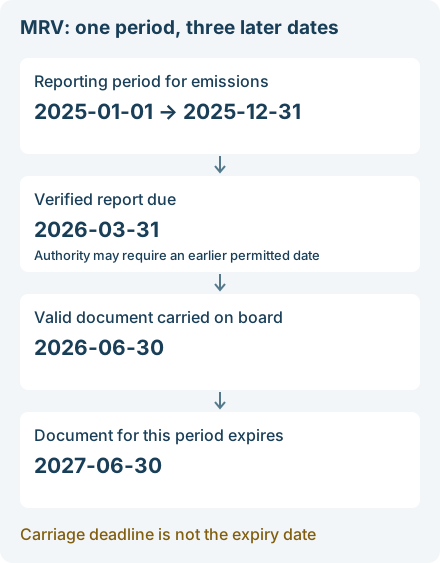
Each date follows the same reporting period described above. While preparing the next period’s report, track the previous document’s expiry separately.
Missing two consecutive periods leads to an expulsion order
Member States set up a system of penalties for failure to comply with the monitoring and reporting obligations and take the measures necessary to ensure they are imposed. Above that there is one more step.
There are two conditions: the ship has failed to comply with the monitoring and reporting obligations for two or more consecutive reporting periods, and other enforcement measures have failed to ensure compliance. The competent authority of the Member State of the port of entry may then, after giving the company the opportunity to submit its observations, issue an expulsion order. It is notified to the Commission, the European Maritime Safety Agency, the other Member States and the flag State concerned.
Worth confirming
The passages above come from Regulation 2015/757. Whether the administering authority has brought the deadline forward, who the verifier is, and how the technical rules for data exchange formats were set have to be checked as they actually apply to that ship. When the document of compliance on that ship expires, whether a change of company fell inside this year, and whether the list of voyages has a gap are where the actual judgement starts.
You can consult the cited source documents
These links lead to the official publishers of the documents discussed here. Match the edition and provisions cited in the article; for EU legislation, also consult the consolidated versions and amendment history on the document page.
Continue with the related operational guidance
One of the things the monitoring plan has to describe is the procedure for monitoring the completeness of the list of voyages. Bellbook builds the voyage chain from arrival and departure records and hangs fuel consumption on each voyage, so a missing voyage shows up in the list.
Start for freeRelated reading
- What each ship type records as cargo carried per voyage under EU MRV (EU Regulation 2016/1928)Environment and regulation
- Three ways an electronic record book differs from paper and the Administration's declaration (MEPC.314(74) and MEPC.312(74))Environment and regulation
- Entry into force and application dates of the Canadian Arctic and Norwegian Sea emission control areas (MEPC.392(82))Environment and regulation