IMO DCS Appendix IX amendments and shipboard data collection

The reporting form for the IMO Ship Fuel Oil Consumption Data Collection System (DCS) has changed. Resolution MEPC.385(81) replaced Appendix IX of MARPOL Annex VI in full. The wording in the resolution is “12 Appendix IX is replaced by the following”.
The dates are in the preamble. Adopted 22 March 2024, deemed accepted 1 February 2025 under MARPOL article 16(2)(f)(iii), entered into force 1 August 2025 (paragraph 3). Paragraph 4 adds one line.
4 ALSO INVITES the Parties to consider the early application of the amendments to appendix IX with regard to information to be submitted to the IMO Ship Fuel Oil Consumption Database from 1 January 2025;
Collection starts according to early application and delivery date
MEPC.1/Circ.913 distinguishes the following routes. These are data-collection periods, not the years in which reports are submitted.
| Application route | Start of enhanced data collection |
|---|---|
| Flag implements early | From 2025-01-01; from delivery for ships delivered thereafter |
| Existing reporting ship under a flag applying at entry into force | Keep existing granularity in 2025; switch from 2026-01-01 |
| Ship delivered on or after 2025-08-01 under that flag | From delivery |
Also check the guidance on revising the SEEMP methodology and verification by the Administration or recognized organization before collection begins. Do not assign every ship a 2026 start without checking delivery and flag implementation.
Totals by fuel type no longer fill the form
These are the fuel consumption fields in the replaced Appendix IX. The ones in bold are new.
| Field | Content |
|---|---|
| Total consumption by fuel oil type | Existing |
| Total consumption by fuel oil type and consumer | Main Engine(s) / Auxiliary Engine(s)·Generator(s) / Oil-fired Boiler(s) / Others (specify) |
| Consumption by type and consumer, not under way | Split again across the same four consumers |
| Total distance travelled (nm) | Existing |
| Laden distance travelled (nm) | New, voluntary submission |
| Hours under way | Existing |
| Total shore power received (kWh) | New |
The particulars section also gained Net tonnage (NT), Attained EEXI and Ice class.
Ships to which regulation 28 (CII) applies report Total transport work, the applicable CII type (AER or cgDIST), the required annual operational CII, the attained CII before and after correction, whether innovative technology is installed, and the operational carbon intensity rating in the same form. That is why the resolution title calls this amendment “inclusion of data on transport work and enhanced granularity”.
Check accepted alternatives when direct consumer measurement is unavailable
A single total cannot uniquely determine several consumer values. That does not mean direct measurement is the only permitted method. MEPC.395(82) paragraphs 7.3 and 7.4 distinguish flow meters, tank monitoring and conditional subtraction or estimation.
Where only one consumer value is unavailable, subtraction of the other consumers from the measured annual total may be considered. If the preceding methods cannot be used, an estimation method must satisfy the Administration or recognized organization. Describe each consumer’s method and evidence in SEEMP Part II. Do not fill gaps with arbitrary percentages.
Regulation 27.3 requires reporting of aggregates within 3 months after the calendar year ends. Arithmetic in a daily example and acceptance of an annual reporting method are separate checks.
The raw data behind the aggregate must be kept for 12 months
You submit aggregated values, but regulation 27.8 asks separately for what sits underneath.
8 … the disaggregated data that underlies the reported data noted in appendix IX to this Annex for the previous calendar year shall be readily accessible for a period of not less than 12 months from the end of that calendar year and be made available to the Administration upon request.
It must be readily accessible for at least 12 months after the end of the calendar year and produced on request. Now that Appendix IX is split by consumer and by not under way, the raw data has to survive at the same level of detail to satisfy this. Clearing out the original noon reports once the aggregate is done does not meet the requirement.
A change to Appendix IX is a change to SEEMP Part II
Regulation 26.2 requires the SEEMP of a ship of 5,000 gross tonnage and above to include a description of the methodology for collecting the data required by regulation 27.1 and the processes for reporting it to the Administration.
The fields you collect have changed, so the methodology written in the SEEMP has to change with them. If you have started filling in the new fields while the SEEMP still describes the old ones, the document and the practice are saying different things.
Regulation 26.3 applies on top for ship types subject to CII. Sub-paragraph .3 makes the SEEMP “subject to verification and company audits”. A document that disagrees with the practice is therefore something an audit finds.
The threshold is 5,000 gross tonnage
The wording of regulation 27.1:
1 From calendar year 2019, each ship of 5,000 gross tonnage and above shall collect the data specified in appendix IX to this Annex, for that and each subsequent calendar year or portion thereof, as appropriate according to the methodology included in the SEEMP.
“or portion thereof” is there because of regulations 27.4 and 27.5. When the Administration changes, the portion belonging to the previous Administration is reported at that date. When the company changes, the portion belonging to that company is reported at that date. If both happen at once, regulation 27.6 applies the Administration change rule. If a transfer of management is planned, organise the data so it can be cut at the transfer date.
What happens after reporting is also in the regulations. Regulation 27.9 requires the Administration to transfer the reported data to the IMO Ship Fuel Oil Consumption Database within one month of issuing the Statement of Compliance (SoC).
New paragraphs on data disclosure
The same resolution added paragraphs 14 and 15 to regulation 27.
14 On an ad hoc basis, the Secretary-General of the Organization may share data with analytical consultancies and research entities, under strict confidentiality rules.
15 The Secretary-General of the Organization, on the request of a company, shall grant access to the fuel oil consumption reports of the company’s owned ship(s) in a non-anonymized form to the general public.
Paragraph 14 lets the Secretary-General share data with analytical and research entities under strict confidentiality rules. Paragraph 15 makes the reports of a company’s owned ships available to the general public in non-anonymized form on the request of that company, so it only moves when the company asks.
Do not equate not under way with being stationary in port
MEPC.401(83) defines under way as the interval from FAOP to EOSP and treats canal passage as not under way. Do not classify the states solely by departure, arrival or speed.
MEPC.413(84) revises the guidance to include distance in both states in total distance travelled. Setting all not-under-way distance to 0 can therefore omit distance. MEPC.1/Circ.925 consolidates both amendments.
Reconcile fuel, time and distance separately in a fictional day
This is a Bellbook calculation example, not actual ship performance or recommended operation. Assume one fuel type, MGO, a fixed UTC clock, FAOP at 06:00, EOSP at 22:00 and no canal passage. Fuel is in t and distance in nm. The first and last intervals include manoeuvring distance.
| UTC interval | State | Main engine t | Generator t | Boiler t | Other t | Distance nm |
|---|---|---|---|---|---|---|
| 00:00–06:00 | not under way | 2 | 3 | 1 | 0 | 10 |
| 06:00–22:00 | under way | 32 | 6 | 2 | 0 | 320 |
| 22:00–24:00 | not under way | 2 | 1 | 1 | 0 | 5 |
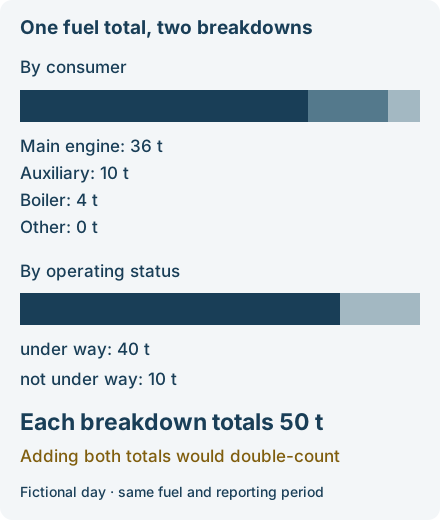
The bars classify the same day’s fuel in two ways. Do not add the operating-status total to the consumer total. Match the fuel type and reporting period before comparing each breakdown against the source records.
- Consumer totals: main engine 36 + generator 10 + boiler 4 + other 0 = 50 t.
- State totals: under way 40 + not under way 10 = 50 t. The 10 t not under way is already within the total; do not add it again.
- Hours under way: 22:00 − 06:00 = 16 hours. Do not multiply the same elapsed time by the number of consumers.
- Total distance: 10 + 320 + 5 = 335 nm. By state: under way 320 nm and not under way 15 nm.
If a separate total record shows 49.5 t, the difference is 50 − 49.5 = 0.5 t. Do not reduce the boiler figure arbitrarily to make the gap disappear. Compare periods, fuel types, units, measurement corrections, omissions, duplicates and source records first. This example sets no acceptance tolerance.
Reproduce the figures with the example and review files
The fictional DCS record CSV contains the same three intervals. Start and end use ISO timestamps; each end matches the next start, covering a continuous day. There is no total column. Sum the consumer columns to reproduce the results above.
The DCS review CSV records the reporting period, fuel type, total reference, consumer sum, both state totals, distance and hours, discrepancy, evidence, reviewer and action. It is an aid, not an official submission form or automatic compliance tool. Do not add shore-power kWh to fuel t or calculate CII from fuel quantity alone.
Separate current guidance from future Convention amendments
Checked on 2026-09-28. The Convention amendments in MEPC.407(84) are scheduled to enter into force on 2027-09-01, subject to acceptance. They include changes to reporting-period entries and data access; do not treat them as already in force. Track the current SEEMP guidance amended by MEPC.413(84) separately from that future Convention entry into force.
What to check now
- Whether the noon report or daily consumption record is split into main engine, auxiliary engines, boilers and others
- Whether FAOP, EOSP and canal records distinguish under way from not under way, with distance retained for both states
- Whether shore power received (kWh) is recorded, for ships that take it
- Whether the data collection methodology in SEEMP Part II reflects the new Appendix IX fields
- Whether your flag State or recognised organisation has asked for early application for 2025
Sources
- MEPC.385(81) (adopted 2024-03-22, in force 2025-08-01). Appendix IX replacement, new paragraphs 14 and 15 in regulation 27. Checked against
MEPC.385(81).pdf, PDF pages 4-6 (document pages 3-5). - MEPC.328(76) 2021 revised MARPOL Annex VI. Regulation 26 (SEEMP), regulation 27 (collection and reporting). Checked against
MEPC.328(76).pdf, pp.45-46. - The form and the date it applies from depend on the revision and on whether your flag State adopted early application. Submit on the basis of the current guidance from your flag State and recognised organisation.
This update adds delivery-dependent collection dates, conditions for subtraction and estimation, state definitions and total-distance treatment. The fictional totals were checked against the published CSV. It does not replace individual flag approval or external expert review.
You can consult the cited source documents
These links lead to the official publishers of the documents discussed here. Match the edition and provisions cited in the article, and check subsequent amendments and flag-state implementation before applying them.
- IMO · MEPC.328(76)
- IMO · MEPC.385(81)
- IMO · MEPC.395(82)
- IMO · MEPC.401(83)
- IMO · MEPC.413(84)
- IMO · MEPC.407(84)
- IMO · MEPC.1/Circ.913 · MEPC.1/Circ.925
Continue with the related operational guidance
Noon and arrival/departure reports retain consumption separately for main engines, generators, boilers and others. Before submission, the company should reconcile source records and aggregates against the methods and operating-state classification in SEEMP Part II.
Start for freeRelated reading
- What each ship type records as cargo carried per voyage under EU MRV (EU Regulation 2016/1928)Environment and regulation
- Three ways an electronic record book differs from paper and the Administration's declaration (MEPC.314(74) and MEPC.312(74))Environment and regulation
- Entry into force and application dates of the Canadian Arctic and Norwegian Sea emission control areas (MEPC.392(82))Environment and regulation