The steps in on-board complaint procedures and the right to skip them (MLC Regulation 5.1.5)

MLC, 2006 Regulation 5.1.5 and Standard A5.1.5 set on-board complaint procedures while preserving the right to complain directly to the master or external authorities. Internal stages do not remove that right.
Resolve at the lowest level, but the right to skip always stays
Such procedures shall seek to resolve complaints at the lowest level possible. However, in all cases, seafarers shall have a right to complain directly to the master and, where they consider it necessary, to appropriate external authorities.
The first sentence is the design principle for the procedure; the second is the proviso hung on
it. in all cases. Whatever order the company’s procedure sets out, the right to complain
directly to the master is not subordinate to that order.
External authorities are the same, with one condition attached: where the seafarer considers it necessary. The provision writes in who decides whether it is necessary, and it is the seafarer.
Guideline B5.1.5 records the reason for this structure. Many complaints relate specifically to the individuals to whom the complaint is to be made, or even to the master. Where the next step in the procedure is the other party, forcing that step stops the procedure working.
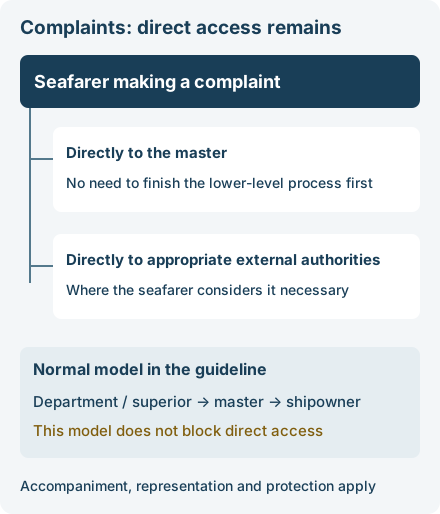
For example, if the complaint concerns the department head, completion of that person’s handling is not a prerequisite for direct access. The normal model below comes from the guideline; the direct-access rights above it are protected by the mandatory standard. Use the ship’s copy of the procedure provided to the seafarer to locate actual contacts and support.
The definition of victimization is drawn wide
The term “victimization” covers any adverse action taken by any person with respect to a seafarer for lodging a complaint which is not manifestly vexatious or maliciously made.
Three places to look. First, the actor is any person. Not narrowed to the company or a
superior. Second, the act is any adverse action. Not narrowed to formal measures such as
discipline. Third, the reach of the protected complaint: anything that is not manifestly
vexatious or maliciously made is inside the protection.
The third matters in practice. Where a complaint turns out to be unfounded, that fact alone does not remove the protection. What falls outside is a complaint manifestly vexatious or maliciously made.
Regulation 5.1.5 paragraph 2 requires flag States to prohibit and penalize victimization. Not only prohibit; penalize is written in as well.
There is a right to be accompanied and represented during the procedure
Standard A5.1.5 paragraph 3 requires the procedures to include the seafarer’s right to be accompanied or represented during the complaints procedure. Guideline B5.1.5 reads that party as another seafarer of the complainant’s own choice on board the ship, available at all times.
What has to be handed to the seafarer is not only the agreement
- In addition to a copy of their seafarers’ employment agreement, all seafarers shall be provided with a copy of the on-board complaint procedures applicable on the ship. This shall include contact information for the competent authority in the flag State and, where different, in the seafarers’ country of residence, and the name of a person or persons on board the ship who can, on a confidential basis, provide seafarers with impartial advice on their complaint and otherwise assist them in following the complaint procedures available to them on board the ship.
Four strands have to be handed over.
| What has to be provided | Condition |
|---|---|
| A copy of the seafarers’ employment agreement | Every seafarer |
| A copy of the on-board complaint procedures applicable on the ship | Every seafarer |
| Contact information for the competent authority in the flag State | Included in the copy of the procedures |
| Contact information in the seafarer’s country of residence | Included where different from the flag State |
One more thing attaches: a name. The name of a person or persons on board who can, on a confidential basis, give impartial advice on the complaint and help the seafarer follow the procedures. What the provision asks for is a name, not a role.
The steps the guideline draws, and the record it asks for
Guideline B5.1.5 draws the model procedure like this. The complaint is addressed to the head of the complainant’s department or to a superior officer, who attempts to resolve it within prescribed time limits appropriate to the seriousness of the issue. Unresolved, it goes to the master, who handles it personally. Unresolved on board, it goes ashore to the shipowner, who is given an appropriate time limit as well.
The requirement about records sits in the same place.
(e) all complaints and the decisions on them should be recorded and a copy provided to the seafarer concerned;
All complaints and the decisions on them should be recorded, with a copy to the seafarer concerned. Being a guideline it is not mandatory, but without it there is no way left to confirm that the earlier steps were actually taken.
The procedure does not close off other remedies
Regulation 5.1.5 paragraph 3 states that this Regulation and the related Code sections are without prejudice to a seafarer’s right to seek redress through whatever legal means the seafarer considers appropriate. This is not a structure where the on-board steps have to be exhausted before anything can go outside.
Worth confirming
The passages above come from printed pages 91 to 93 of the consolidated MLC, 2006 (including the 2022 amendments). The concrete shape of the procedure and its time limits are set by flag State law and collective agreements. Whether the copy of the procedures on that ship actually carries the flag State and country of residence contacts, whether the name of the on-board adviser is filled in, and whether past complaints and the decisions on them are on record are where the actual judgement starts.
You can consult the cited source documents
These links lead to the official publishers of the documents discussed here. Match the edition and provisions cited in the article, and check subsequent amendments and flag-state implementation before applying them.
Continue with the related operational guidance
The provision requires a copy of the employment agreement and a copy of the complaint procedures to be given to the seafarer. Bellbook keeps the seafarer's agreement in their own account, so it can be opened during the voyage without hunting for paper.
Start for freeRelated reading
- How reports from pilots and port authorities lead to a PSC inspection (EU Directive 2009/16 Article 23)Inspections and audits
- The order and duration of the Interim DOC and Interim SMC on the day the company changes (ISM Code chapter 14)Inspections and audits
- Seven HSSC survey types, the anniversary window, where the new period starts by renewal timing and how an extension is counted (Resolution A.1120(30))Inspections and audits