Paris MoU load line inspections, matching documents, closing devices and marks, and when overloading leads to detention (PSCC 58/2025/12)
PSCOs in Paris MoU ports use PSCC 58/2025/12 when they look at load lines. In 10 pages it sets out how the International Convention on Load Lines 1966 (LL66) and its 1988 Protocol are applied during inspections. It is guidance for PSCOs. PSCC instructions do not restrict the PSCO in the scope of inspection (PSCC 59/2026/02 section 1.1), and this guidance itself says its lists of clear grounds and detainable deficiencies are not exhaustive.
This article follows the order of the guidance: what the ship should have ready, where the PSCO looks, and where the detention decision turns. Convention text such as freeboard values and seasonal zones was not among the sources checked here, so it is not covered.
Scope: PSC inspections in ports of Paris MoU Authorities. The guidance states that the Convention applies to new ships of 24 m in length and upwards and existing ships of 150 gross tonnage or more engaged in international voyages.
A certificate within its dates can still cease to be valid in three cases
The guidance opens the initial inspection with Article 19(9) of the Convention. An endorsed International Load Line Certificate ceases to be valid in any of these cases.
- Material alterations to the hull or superstructures would require an increased freeboard.
- The fittings and appliances for the protection of openings, guard rails, freeing ports and means of access to crew quarters are not maintained in an effective condition.
- Structural strength has been lowered so far that the ship is unsafe to operate at the assigned freeboard.
Read with the second line, a broken hatch securing device or freeing port is not just an equipment defect. It is tied to the conditions for the certificate’s validity. The initial inspection in the guidance includes an overall visual check of the hull: from the quay for the side facing it, from the main deck for the opposite side, or from the boat when boarding at sea.
Documents that must be on board are mixed with ones that need not be
The guidance uses different wording for different documents. Sorting them into Convention requirements, items the PSCO checks and items whose carriage is only recommended gives the following.
| Document | Wording in the guidance |
|---|---|
| International Load Line Certificate | Issued to every ship surveyed and marked under the Convention |
| Load Line Exemption Certificate | If the ship holds an exemption under Article 6, the PSCO checks that a valid one is on board |
| Loading and ballasting information in an approved form | Checked to be on board, or proof that the Administration does not require it |
| Approved stability booklet and strength data if needed | Checked to be on board. Where required, an approved Loading Manual is also checked |
| Evidence of thickness measurements at renewal surveys | Must be on board ships under ESP or CAS |
| Record of Conditions of Assignment | Not required on board by the Convention. A footnote recommends keeping a copy |
The record in the last line is not mandatory, but it returns later in the guidance as a reference. Materials, type and position of sea inlet and discharge valves are accepted on the basis of this record. No further investigation is required unless clear grounds for non-compliance are found. Coaming heights are measured at random when there are grounds to believe they differ from it. A footnote says the record is valid for the life of the ship provided no changes are made.
Stability data has a construction date boundary. Ships built before 2010-07-01 follow an intact stability standard acceptable to the Administration. Ships built after that comply at least with Part A of the IS Code 2008. Type A, B-60 and B-100 ships have separate damage stability requirements, and ships assigned a timber freeboard keep margins of stability when carrying timber deck cargoes.
With clear grounds the PSCO looks at the condition of thirteen areas
The guidance lists six clear grounds. The first three are missing equipment required by the Convention, a clearly invalid certificate, and the documents above being missing, incomplete or falsely maintained. The next two are hull deterioration that may put watertight or weathertight integrity at risk and serious deficiencies in safety construction. The last is information or evidence that the master or crew are not familiar with essential operations for integrity, stability and crew protection.
A more detailed inspection covers at least thirteen areas. On the hull side these are hull and deck plating, bulwarks and guard rails, and superstructures, deckhouses and exposed engine casings. On the openings side they are miscellaneous openings in exposed decks, cargo hatches and securing devices, small hatches and skylights, ventilators, air pipes and sounding pipes. The rest are side scuttles and windows, shell doors, scuppers, inlets and discharges, and walkways on tankers.
Annex 2 lists items for closer examination. These are the ones a ship should know in advance.
- Gas tankers, chemical tankers, oil tankers, bulk carriers of 150 m in length or above, and passenger ships of 120 m or more or with three or more main vertical zones must carry an approved stability instrument.
- For ships with damage stability requirements, such as types A, B-60 and B-100, the guidance recommends that the instrument be able to check damage conditions as well.
- The PSCO may ask for cargo hatch covers to be operated if this does not interfere with cargo operations.
- If weathertightness is in doubt, a hose test may be requested. However, the PSCO should not request it if the master determines that it could endanger the ship, crew or cargo.
- Records of ultrasonic or hose tests of hatch covers from the last renewal or intermediate survey can be considered when judging weathertightness.
- Bulwarks and guard rails at least 1 m above the deck must be in good condition. Areas around freeing ports must be free of obstructions to drainage.
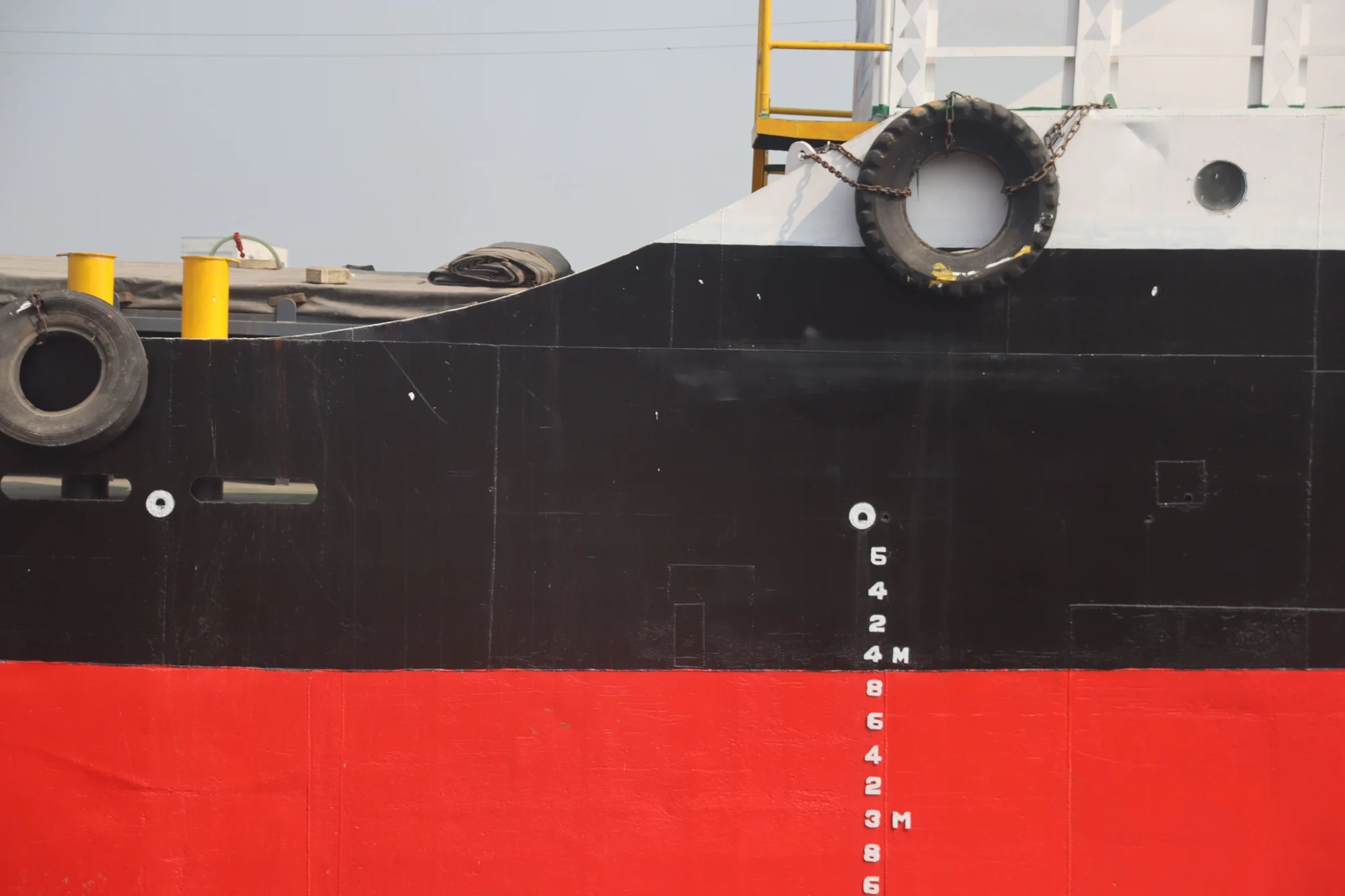
- Load line marks (deck line, load lines, mark of the assigning authority) must match the certificate and be permanent and in a contrasting colour.
A ship with two load line assignments must show the marks that match the certificate presented
Bulk carriers, general cargo ships and tankers may hold concurrent load line assignments. The guidance says only one set of marks should be displayed in a contrasting colour on the ship’s side. The certificate presented to the PSCO should be the one for that mark only. The PSCO then checks that other certificates affected by the change in deadweight or load lines, for example the IOPP or IEE, are consistent with the freeboard assigned at the time of inspection.
The following situation is invented for illustration. A bulk carrier holding assignments A and B arrives with the marks for assignment B painted on.
| Document produced | Relation to the marks | Result under the guidance |
|---|---|---|
| Load Line Certificate for assignment B | Matches | In order |
| Load Line Certificate for assignment A | Does not match | Breaks the rule of one certificate for the displayed mark |
| IOPP supplement showing the deadweight of assignment A | Does not match | Subject to the check against the freeboard at inspection |
If only the marks are repainted on the day the assignment changes and the certificate file stays as it was, the ship ends up in the second and third lines of this table. With grounds for non-compliance, the PSCO may ask for the marks and freeboard to be measured.
Treatment depends on when the marks are submerged
The guidance puts a ship that arrives with the ring or applicable marks submerged beyond the limits of its certificates up for detention, unless force majeure is demonstrated. A ship overloaded before departure is also considered for detention until the situation is rectified. Alongside, the position is different.
the Convention does not cover submersion of the marks when alongside
The guidance notes that marks may be submerged naturally alongside, for example during cargo operations. It then sums up that the marks should not be submerged when the ship is on a voyage, puts to sea or arrives. The following voyage is invented for illustration.
| Moment | State of the marks | Treatment under the guidance |
|---|---|---|
| Arrival | Submerged beyond the permitted limits | Considered for detention, unless force majeure is shown |
| Alongside during loading | Briefly submerged by cargo operations | Not covered by the Convention |
| After loading, before departure | Submerged beyond the permitted limits | Considered for detention until rectified |
Bulk carriers have one more ground for detention. If empty or alternate hold loading does not comply with SOLAS Chapter XII Regulation 5.1, or heavy cargoes do not comply with the booklet restrictions under SOLAS Chapter VI Regulation 7.2, detention is considered. This applies especially where the hull may have been overstressed. At the end of this item, which covers marks submerged on arrival, overloading before departure and bulk carrier loading, the guidance says the flag Administration or RO is informed.
The detention list is illustrative, and corrosion turns on temporary repairs
Section 3.2 of the guidance gives examples of deficiencies that may warrant detention. They include the lack of valid certificates and documents, means of freeing water from the deck not operational, and absent, substantially deteriorated or defective closing devices, hatch closing arrangements and watertight doors. Overloading, a loading condition that fails the criteria in the approved stability booklet, and draught or freeboard marks that cannot be read are also there. So are the absence of approved loading and stability information and problems with ESP or CAS documentation.
Corrosion and damage need a separate reading. Damage or corrosion in decks and hull affecting seaworthiness or strength to take local loads may warrant detention. The exception is a voyage to a port for permanent repairs after temporary repairs approved by the flag Administration or RO. Annex 2 also says damage that does not affect seaworthiness is not a reason to detain.
If the PSCO sees significant structural deterioration, the RO or flag Administration is consulted on whether a further survey is needed. Thickness measurement records may be taken into account if available, but the consultation happens either way. Repairs are proposed by the RO and flag. If the PSCO has clear doubts about those proposals and the strength of the hull, the PSCO may ask for a calculation showing that the structure still complies with the rules.
Worth confirming
Some points are left out because PSCC 58/2025/12 and the other Paris MoU sources checked for this article do not answer them.
- Freeboard values, seasonal zones and the dimensions of the marks. The guidance only points to Convention regulation numbers, and the Convention text was not among the sources.
- How force majeure is demonstrated. The guidance states the exception but not the proof.
- A numerical threshold for corrosion that affects seaworthiness.
- The separate guidance on checking thickness measurements on ships outside ESP and CAS that the guidance refers to. It is not among the Paris MoU sources checked here.
PSCC instructions are revised over time. Before an actual inspection, check the latest edition on the Paris MoU site.
You can consult the cited source documents
These links lead to the official publishers of the documents discussed here. Match the edition and provisions cited in the article, and check subsequent amendments and flag-state implementation before applying them.
Continue with the related operational guidance
The first detainable item in the guidance is the lack of valid certificates and documents. When you pick the International Load Line Certificate on the Bellbook ship certificates screen, the usual 5-year expiry is filled in, and each annual survey you add stacks up a completion date from which the next survey date is calculated.
Start for freeRelated reading
- PSC inspections of ships carrying industrial personnel, application, headcount, training records and detention grounds (Paris MoU PSCC 57/2024/06)Crew and labour
- How Paris MoU PSCOs match seafarer certificates, flag State endorsements and the minimum safe manning document (PSCC 57/2024/05)Crew and labour
- What the Paris MoU PSCO checks on ECDIS, backup, ENC updating and the watch officer's demonstration (PSCC 58/2025/06)Inspections and audits