Seafarer rest hour limits per 24-hour and 7-day window and how violations are judged

Minimum rest is ten hours in any 24-hour period and 77 hours in any seven-day period. Calendar-day totals alone cannot establish compliance; the limits apply to every consecutive period of the specified length.
This article puts the wording of MLC, 2006 Standard A2.3 and STCW Code Section A-VIII/1 side by side and sets out what the two instruments actually require.
Check your records with the rest-hours tool
Enter work and rest records to find rolling 24-hour and 7-day shortfalls and missing data.
Use every consecutive 24-hour and 7-day period
MLC Standard A2.3, paragraph 5 uses the words in any 24-hour period and
in any seven-day period.
- The limits on hours of work or rest shall be as follows: (a) maximum hours of work shall not exceed: (i) 14 hours in any 24-hour period; and (ii) 72 hours in any seven-day period; or (b) minimum hours of rest shall not be less than: (i) ten hours in any 24-hour period; and (ii) 77 hours in any seven-day period.
any means any. Not the day that runs from 00:00 to 24:00, but a period that holds wherever
its start is placed. So a schedule whose per-date totals both clear ten hours can still fall
short of ten hours in a 24-hour window that straddles the two dates.
Ten hours on each date can leave only four hours in a rolling day
This is a fictional calculation example created by Bellbook, not a vessel case study or a recommended watch schedule. Assume no clock changes, work outside the listed rest periods, and no exceptions.
| Date | Rest | Remaining work | Daily rest |
|---|---|---|---|
| First day | 00:00–06:00, 14:00–18:00 | 06:00–14:00, 18:00–24:00 | 6 + 4 = 10 hours |
| Second day | 06:00–12:00, 20:00–24:00 | 00:00–06:00, 12:00–20:00 | 6 + 4 = 10 hours |
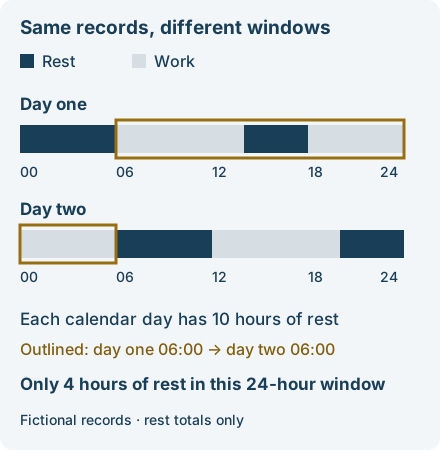
Dark bars show rest; pale bars show work. The outlined sections form the inspection window. Adding only the rest inside that window gives a different result from adding rest within calendar dates.
Take the window from 06:00 on the first day to 06:00 on the second. The first morning’s rest is outside it, and the second morning’s rest starts when it ends. Only 14:00–18:00 on the first day remains: 4 hours, a shortfall of 6 hours against the ordinary minimum.
This establishes only the rest total for that window. It does not establish compliance for other windows or the division of rest. There is no record after the second day, so later windows cannot be assessed.
For each rest interval, add only the time overlapping the assessment window. Include the start and exclude the end so boundary instants are not counted twice.
- Overlap start = the later of the rest start and window start.
- Overlap end = the earlier of the rest end and window end.
- Overlap duration = the difference, or zero when the end precedes the start.
To find the minimum, check where either end of the window crosses a work/rest transition. Candidate starts are each transition and each transition minus the window length, plus record boundaries. Evaluate only windows fully covered by the record. This calculates recorded time; it cannot reconstruct unrecorded call-outs.
The weekly work and rest limits differ by 19 hours
MLC paragraph 5 puts or between (a) and (b). Check the flag State’s implementation and the ship’s DMLC Part I. Choosing a work-hour regime under MLC does not remove STCW rest obligations for seafarers to whom they apply.
The two are not the same rule written twice. Seven days is 168 hours, and subtracting 77 hours of rest leaves 91 hours. That arithmetic remainder is 19 hours above the 72-hour work ceiling. Actual work schedules must also satisfy the other rest and subdivision requirements.
The words this term does not include short breaks in A2.3 paragraph 1(b) exclude short breaks from qualifying rest. They do not by themselves establish that those breaks are also excluded from work. The 91 hours left by subtracting 77 from 168 are an arithmetic remainder, not permission to allocate all that time to work.
This is why you have to know which regime a ship’s flag State chose before you check the records. The table posted on board carries that value too (A2.3, paragraph 10(b)).
Check the total, number of rest periods and intervals
Even with ten hours secured in 24, how those ten hours were divided is a separate requirement.
- Hours of rest may be divided into no more than two periods, one of which shall be at least six hours in length, and the interval between consecutive periods of rest shall not exceed 14 hours.
Three conditions bind at once. Rest may be split into no more than two periods, one of them must be at least six hours, and the interval between two consecutive rest periods cannot exceed 14 hours. STCW Code Section A-VIII/1, paragraph 3 is the same sentence.
The interval threshold is more than 14 hours. An interval of exactly 14 hours does not fail this test alone. The total and division of rest must still be checked separately.
The table separates checks under the ordinary limits. Do not decide division compliance simply by counting boxes split at midnight. Check continuous rest periods and the totals for rolling 24-hour and 7-day windows separately.
| Violation | Provision | Value it is judged on |
|---|---|---|
| Under ten hours | A2.3 paragraph 5, A-VIII/1 paragraph 2 | Minimum rest in any 24-hour window |
| Under 77 hours | A2.3 paragraph 5, A-VIII/1 paragraph 2 | Minimum rest in any 7-day window |
| More than two periods | A2.3 paragraph 6, A-VIII/1 paragraph 3 | Rest arrangement in the assessed 24-hour period |
| No six-hour period | A2.3 paragraph 6, A-VIII/1 paragraph 3 | Longest single rest period |
| Interval over 14 hours | A2.3 paragraph 6, A-VIII/1 paragraph 3 | Longest work run between rests |
Each is fixed a different way, so writing “non-compliant that day” in one line leaves you without the thing to change next.
STCW and MLC do not apply to the same people
The identical numbers make it easy to treat these as one rule, but their scope differs.
STCW Code Section A-VIII/1, paragraph 2 states who is covered.
2 All persons who are assigned duty as officer in charge of a watch or as a rating forming part of a watch and those whose duties involve designated safety, prevention of pollution and security duties shall be provided with a rest period of not less than:
The STCW provision covers watch officers, watch ratings and persons with designated safety, pollution-prevention or security duties. On MLC-covered ships, seafarers must be assessed against the flag State’s work/rest implementation whether or not they stand a watch.
That is why a watch schedule alone cannot demonstrate rest hour compliance. The records of positions that stand no watch have to be there as well.
When exceptions open, STCW gives numbers and MLC gives a procedure
Both instruments allow exceptions, by different means.
STCW Code Section A-VIII/1, paragraph 9 pins the limit of an exception to a number.
9 Parties may allow exceptions from the required hours of rest in paragraphs 2.2 and 3 above provided that the rest period is not less than 70 hours in any 7-day period.
The same paragraph limits weekly exceptions to two consecutive weeks and requires an interval at least twice the exception’s duration. A division exception retains the daily minimum of ten hours but permits up to three periods: one of at least six hours, the others at least one hour each, with intervals no longer than 14 hours. The division exception is limited to two 24-hour periods in seven days. It does not reduce the ten-hour total.
MLC Standard A2.3, paragraph 13 sets a procedure instead of a number. Exceptions open only through national laws or regulations, or through a collective agreement authorized or registered by the competent authority. A company and a seafarer cannot open one between themselves.
So a record that applies an exception needs two grounds: which exception provision it is, and what the flag State’s basis for allowing it is.
Minimize disturbance from drills and provide compensatory rest after call-outs
Musters and fire-fighting and lifeboat drills must minimize disturbance of rest and avoid inducing fatigue (A2.3 paragraph 7; A-VIII/1 paragraph 4). Record actual drills and call-outs, and check the rest secured afterwards.
Where a seafarer is on call, such as when a machinery space is unattended, one more condition applies. If a call-out disturbs the normal period of rest, an adequate compensatory rest period is due (A2.3, paragraph 8; A-VIII/1, paragraph 6). A record that notes the call-out but not the compensatory rest does not evidence the requirement.
The master’s authority has the same shape. For the immediate safety of the ship, persons on board or cargo, the master may suspend the schedule and require the hours of work needed (A2.3, paragraph 14; A-VIII/1, paragraph 8). The same provision then requires that, as soon as practicable after the normal situation is restored, an adequate period of rest is provided. The authority does not remove the record. It adds one more thing to do afterwards.
The record needs two signatures, the master’s and the seafarer’s
The record requirement covers format, language, the copy and the signatures.
- Each Member shall require that records of seafarers’ daily hours of work or of their daily hours of rest be maintained to allow monitoring of compliance with paragraphs 5 to 11 inclusive of this Standard.
The same paragraph continues. Records are kept in a standardized format established by the competent authority, in the working language or languages of the ship and in English. Seafarers receive a copy of the records pertaining to them, and those records are endorsed by the master, or a person authorized by the master, and by the seafarers. STCW Code Section A-VIII/1, paragraph 7 requires the same standardized format, copy and two endorsements, without naming who establishes the format.
The two signatures matter. A record without the seafarer’s endorsement does not meet the requirement even if the format is right. And whether the copy was handed over does not show up in the record itself, so that has to be handled as a procedure.
Posting is a separate duty. The table of shipboard working arrangements is posted in an easily accessible place, and for every position it states the schedule of service at sea and in port and the applicable maximum hours of work or minimum hours of rest (A2.3, paragraph 10). That table is also in a standardized format, in the working language or languages of the ship and in English (paragraph 11).
What to check
- Whether the ship’s flag State chose the work-hour ceiling or the rest-hour floor
- Whether judgement is made on calendar-day totals or by sliding the window
- Whether violations are recorded as one thing or as the five separate types
- Whether records that apply an exception carry the flag State’s basis
- Whether the seafarer’s signature is on the record
The wording of these provisions can differ between editions. The quotations above are from MLC, 2006 as amended, including the 2022 amendments, and from the Manila Amendments to the STCW Code (STCW/CONF.2/34). Where a flag State has set a stricter standard, that standard comes first.
Check the daily and weekly totals separately
Repeat exactly ten hours of rest at the same times each day. Over seven consecutive days, the total is 10 × 7 = 70 hours, 7 hours short of the ordinary 77-hour minimum. Meeting the daily minimum alone is insufficient.
Conversely, a seven-day total above 77 hours does not cure the four-hour window above. Later rest does not turn an already recorded shortfall into a compliant period.
Download the example and a review worksheet
- Two-day example CSV: all work and rest intervals from the table, using fictional dates and a fixed UTC offset.
- Review worksheet CSV: a blank input sheet, without formulas or automatic compliance decisions.
Open the CSV in a spreadsheet such as Excel. Intervals include their start and exclude their end. The example’s +09:00 offset does not identify a flag State. In your own records, enter the actual offset; distinguish offsets before and after a shipboard clock change.
Each worksheet row records a seafarer identifier, start, end, status (REST·WORK·UNKNOWN), duty or call-out reason, follow-up rest, supporting record and reviewer. Missing time is not automatically rest. Resolve overlaps and reversed intervals first.
This is a supporting review worksheet. It does not replace the standardized record, endorsements and seafarer’s copy required by MLC A2.3 paragraph 12.
Record the deficient window and the follow-up action together
- Identify the flag requirements, covered seafarer and any authorized exception.
- Collect actual work/rest records, including midnight crossings, call-outs, drills and clock changes.
- Check coverage of the entire window. Leave gaps undecided and obtain the underlying record.
- Record the window start and end, rest total and applicable standard. Review totals, division and intervals separately.
- Have the master or responsible person review duty changes and follow-up rest, and record implementation. Do not erase the original shortfall.
Sources and corrections are available for inspection
Sources were checked on 2026-09-28. The provisions in these editions were compared; this is not a review of every flag State’s current implementation.
- ILO MLC consolidated text including the 2022 amendments: A2.3 work/rest standards and records.
- IMO STCW/CONF.2/34: A-VIII/1, printed pages 219–220, rest and exceptions.
This revision replaces the incomplete midnight example with a full schedule and corrects the 14-hour boundary, short-break classification and STCW division exception. The calculation example was checked against the downloadable CSV. This does not imply review by an externally qualified specialist.
Continue with the related operational guidance
Seafarers enter rest on a 30-minute grid on board, and every 24-hour and 7-day window is scanned for its minimum rest. The 10 hours, 77 hours, number of periods, 6-hour period and 14-hour interval are each judged separately. Gaps in the record are left undecided rather than filled with zero.
Start for freeRelated reading
- Medical certificate validity and the eyesight standards that allow no discretion (STCW Regulation I/9 and Code A-I/9)Crew and labour
- Watch ratings and able seafarers compared in four cells by age and seagoing service (STCW Regulations II/4, II/5, III/4 and III/5)Crew and labour
- Electro-technical officer and electro-technical rating compared, and the three routes of seagoing service (STCW Regulations III/6 and III/7)Crew and labour