Basic and advanced tanker cargo training and who is called to each (STCW Regulations V/1-1 and V/1-2)

A second officer with 3 years on chemical tankers who moves to an LPG carrier as chief mate needs the qualifications for the new ship type and cargo responsibilities. Previous experience alone does not establish eligibility.
STCW Regulations V/1-1 and V/1-2 provide five certificates, distinguished by basic or advanced level and by oil, chemical or gas tanker duties.
Approved seagoing service may replace a basic course. At advanced level, the required service is additional to the approved course.
Select the tanker type and duties before comparing qualification routes
The diagram separates selection of the certificate from its qualification requirements. The named advanced-training ranks are master, chief engineer, chief mate and second engineer; anyone else with immediate responsibility for cargo operations is also included. Service and a course are alternatives at the basic level, while the service or onboard-training route and the advanced course are both required at the advanced level.
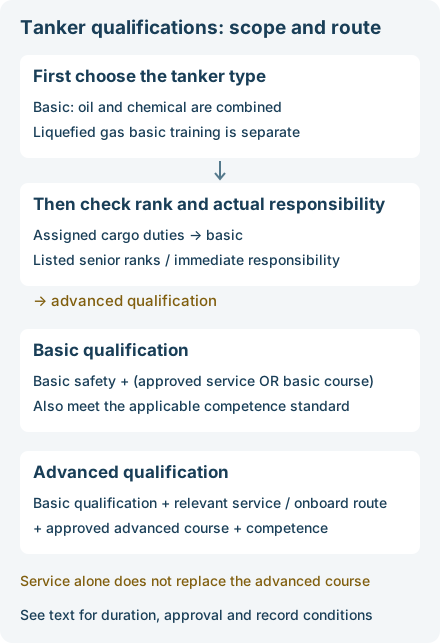
What calls for the basic certificate is the assigned cargo duty, not the rank
1 Officers and ratings assigned specific duties and responsibilities related to cargo or cargo equipment on oil or chemical tankers shall hold a certificate in basic training for oil and chemical tanker cargo operations.
Officers and ratings covers both officers and ratings. The requirement depends on assigned duties and responsibilities involving cargo or cargo equipment.
So the same rank splits from ship to ship. The provision asks for no certificate from a person with no cargo duty, and a rating who is given a duty on cargo equipment needs the basic certificate.
The name of the certificate is worth reading as well.
basic training for oil and chemical tanker cargo operations carries oil tankers and chemical
tankers inside one name. At the basic level the two do not separate.
At the basic level, seagoing service stands in for the course
2 Every candidate for a certificate in basic training for oil and chemical tanker cargo operations shall have completed basic training in accordance with provisions of section A-VI/1 of the STCW Code and shall have completed: .1 at least three months of approved seagoing service on oil or chemical tankers and meet the standard of competence specified in section A-V/1-1, paragraph 1 of the STCW Code; or .2 an approved basic training for oil and chemical tanker cargo operations and meet the standard of competence specified in section A-V/1-1, paragraph 1 of the STCW Code.
One condition sits in front: basic training under A-VI/1 has to be completed. Without it the two branches behind it do not open.
The two branches stand in for each other. One is approved seagoing service of 3 months or more, the other is an approved basic course. Either way the requirement to meet the standard of competence in A-V/1-1 paragraph 1 stays attached. What the service replaces is the course, not the standard.
On the service branch the ship type reads oil or chemical tankers. 3 months served on a
chemical tanker counts towards the same basic certificate that covers oil tankers. It is the
same reason the two ship types share one certificate at this level.
Advanced training names four ranks and anyone with immediate cargo responsibility
3 Masters, chief engineer officers, chief mates, second engineer officers and any person with immediate responsibility for loading, discharging, care in transit, handling of cargo, tank cleaning or other cargo-related operations on oil tankers shall hold a certificate in advanced training for oil tanker cargo operations.
The front half is four posts: master, chief engineer officer, chief mate and second engineer officer. These four are caught by name, whether or not a cargo duty has been assigned to them.
The back half is not a post but a responsibility. any person with immediate responsibility
attaches to loading, discharging, care in transit, handling of cargo, tank cleaning and other
cargo-related operations. Because of that sentence the list of people needing advanced training
cannot be drawn from a rank table. Who on that ship carries immediate responsibility for cargo
work has to be settled first.
Paragraph 5 writes the same sentence for chemical tankers, and Regulation V/1-2 paragraph 3 writes it for liquefied gas tankers. The four posts and the responsibility sentence repeat exactly, and only the ship type and the certificate name change.
At the advanced level, service does not replace the course but sits on top of it
4 Every candidate for a certificate in advanced training for oil tanker cargo operations shall: .1 meet the requirements for certification in basic training for oil and chemical tanker cargo operations; and .2 while qualified for certification in basic training for oil and chemical tanker cargo operations, have: .2.1 at least three months of approved seagoing service on oil tankers, or .2.2 at least one month of approved onboard training on oil tankers, in a supernumerary capacity, which includes at least three loading and three unloading operations and is documented in an approved training record book taking into account guidance in section B-V/1; and .3 have completed approved advanced training for oil tanker cargo operations and meet the standard of competence specified in section A-V/1-1, paragraph 2 of the STCW Code.
All three pieces are needed. The first is meeting the requirements for the basic certificate. The second is seagoing service or onboard training. The third is completing approved advanced training and meeting the standard of competence in A-V/1-1 paragraph 2.
The structure where service stood in for the course disappears here. Completing the advanced course sits in the third piece, and service is asked for separately in the second. Filling the service does not let anyone skip the course.
while qualified for certification in basic training requires service while qualified for basic certification. The date the qualifications were met and the administrative issue date of the certificate are not automatically identical. Use approved training and service records to establish when the qualifications were met, and confirm recognition of subsequent service with the issuing authority.
| The two forms of the second piece | Period | What the provision asks for alongside |
|---|---|---|
| Approved seagoing service on that type | 3 months or more | Nothing |
| Approved onboard training on that type | 1 month or more | in a supernumerary capacity, at least 3 loading and 3 unloading operations, entered in an approved training record book |
The lower route is shorter but the conditions are tighter. It is not a structure where the period can be filled first and the record made afterwards.
The ship type of the service narrows as well. At the basic level it was oil tankers and chemical
tankers alike, but advanced oil training reads on oil tankers. Service on a chemical tanker
does not fill the advanced oil requirement.
The oil side and the gas side do not accept each other’s certificates
1 Officers and ratings assigned specific duties and responsibilities related to cargo or cargo equipment on liquefied gas tankers shall hold a certificate in basic training for liquefied gas tanker cargo operations.
Regulation V/1-2 paragraph 1 uses the same structure as Regulation V/1-1 paragraph 1. The certificate name differs. Liquefied gas tankers have their own basic certificate, and the basic certificate that bundles oil tankers with chemical tankers does not reach this far. The standard of competence points at a different section as well.
| Certificate | Standard of competence | Service and training requirement |
|---|---|---|
| Basic (oil and chemical tankers) | A-V/1-1 paragraph 1 | 3 months on that type, or an approved basic course |
| Advanced (oil tankers) | A-V/1-1 paragraph 2 | Basic qualification, 3 months on oil tankers or 1 month onboard training, advanced course |
| Advanced (chemical tankers) | A-V/1-1 paragraph 3 | Basic qualification, 3 months on chemical tankers or 1 month onboard training, advanced course |
| Basic (liquefied gas tankers) | A-V/1-2 paragraph 1 | 3 months on liquefied gas tankers, or an approved basic course |
| Advanced (liquefied gas tankers) | A-V/1-2 paragraph 2 | Basic qualification, 3 months on liquefied gas tankers or 1 month onboard training, advanced course |
The second officer from the opening runs straight into this table. 3 years on chemical tankers does not count towards the service requirement for the basic liquefied gas certificate. And the chief mate seat is one that Regulation V/1-2 paragraph 3 calls by name, so the advanced certificate is needed too.
The certificate comes out in one of two shapes.
7 Administrations shall ensure that a certificate of proficiency is issued to seafarers, who are qualified in accordance with paragraphs 2, 4 or 6 as appropriate, or that an existing certificate of competency or certificate of proficiency is duly endorsed.
Either a separate certificate of proficiency is issued, or an existing certificate of competency
or certificate of proficiency is endorsed. Regulation V/1-2 paragraph 5 writes the same sentence
for liquefied gas tankers. Whichever shape it takes, the requirement behind it is the same.
Worth confirming
The passages above come from Regulations V/1-1 and V/1-2 in STCW/CONF.2/33. What the provisions settle is the types of certificate, the seats that call for them, and the minimum periods.
What counts as approved seagoing service, who approves a course, and what an approved training record book looks like are for the Administration. So is the choice between a separate certificate and an endorsement on one already held. B-V/1 is guidance, not a mandatory provision.
The standards of competence themselves are not in the passages above. Which items each paragraph of A-V/1-1 and A-V/1-2 asks for, and at what level, has to be read from the tables in those sections.
You can consult the cited source documents
These links lead to the official publishers of the documents discussed here. Match the edition and provisions cited in the article, and check subsequent amendments and flag-state implementation before applying them.
Continue with the related operational guidance
The service requirement behind an advanced certificate turns on which ship type and from when. Bellbook keeps certificates by type on the personnel record card, and every period on board stays attached to the ship it was served on.
Start for freeRelated reading
- Medical certificate validity and the eyesight standards that allow no discretion (STCW Regulation I/9 and Code A-I/9)Crew and labour
- Watch ratings and able seafarers compared in four cells by age and seagoing service (STCW Regulations II/4, II/5, III/4 and III/5)Crew and labour
- Electro-technical officer and electro-technical rating compared, and the three routes of seagoing service (STCW Regulations III/6 and III/7)Crew and labour