The six conditions for oil discharge from a tanker cargo area and the ODME, slop tanks and Oil Record Book Part II (MARPOL Annex I Regulation 34)
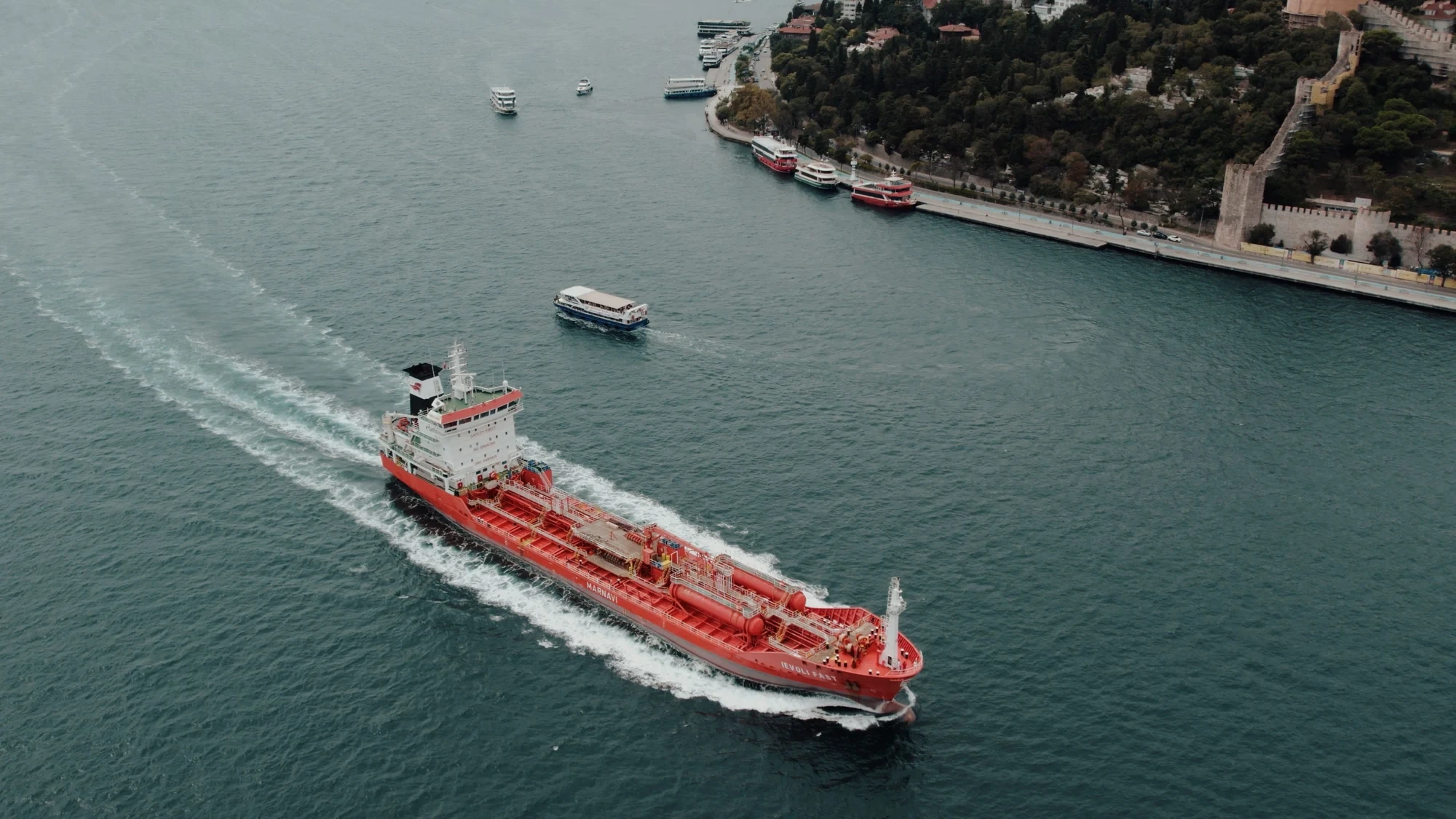
An oil tanker has two routes by which oil can reach the sea. Regulation 15 covers machinery space bilges, and Regulation 34 covers oil and oily mixtures from the cargo area. This article reads Regulation 34 in MARPOL Annex I as revised by resolution MEPC.117(52). It then looks at the three things Regulation 34 assumes, in turn. They are the oil discharge monitoring and control system (ODME) in Regulation 31, the slop tanks in Regulation 29 and the Oil Record Book Part II in Regulation 36.
Machinery space discharge conditions are in the related article below, so only the boundary is covered here. Crude oil washing (Regulations 33 and 35) is outside this article.
Once cargo residue is mixed in, the 15 ppm route closes
Regulation 15 conditionally opens discharge through 15 ppm equipment. But two conditions are aimed at oil tankers. The oily mixture must not originate from cargo pump room bilges (Regulation 15.2.4) and must not be mixed with oil cargo residues (Regulation 15.2.5). A mixture caught by either condition cannot go out through 15 ppm equipment.
| Item | Regulation 15 | Regulation 34 |
|---|---|---|
| Target | Machinery space oily mixtures | Oil and oily mixtures from the cargo area |
| Value judged | Oil content of 15 ppm | Instantaneous rate and total quantity |
| Required equipment | Oil filtering equipment (Regulation 14) | ODME and slop tanks |
| Record | Oil Record Book Part I | Oil Record Book Part II |
A tanker holds both record books. The note on the Part II cover in appendix III requires Part I as well for oil tankers of 150 gross tonnage and above.
Outside special areas all six conditions must be met
The frame of Regulation 34.1 is a prohibition. Discharge is allowed only when the six conditions below are met at once.
| Paragraph | Condition |
|---|---|
| 34.1.1 | Not within a special area |
| 34.1.2 | More than 50 nautical miles from the nearest land |
| 34.1.3 | Proceeding en route |
| 34.1.4 | Instantaneous rate of discharge of oil content at or below 30 litres per nautical mile |
| 34.1.5 | Total quantity at or below 1/30,000 of the particular cargo (1/15,000 for ships delivered on or before 1979-12-31) |
| 34.1.6 | ODME and slop tank arrangement in operation as Regulations 29 and 31 require |
Distance to land is measured from the territorial sea baseline, not the shoreline (Regulation 1.10). Clean and segregated ballast are outside these conditions (Regulation 34.2). Discharges for safety, saving life or resulting from damage are Regulation 4 exceptions.
Clean ballast has its own test. Discharged from a stationary ship on a clear day, it must show no visible oil traces. If ODME evidence shows the effluent did not exceed 15 ppm, the ballast is determined clean even with visible traces (Regulation 1.17). No discharge may contain chemicals introduced to get around the conditions (Regulation 34.8). Residues that cannot be discharged stay on board for reception facilities (Regulation 34.9).
30 litres per nautical mile and 1/30,000 are calculated separately
The instantaneous rate is the oil discharged in litres per hour divided by the ship’s speed in knots at that instant (Regulation 1.12). The total comes from the quantity of the cargo the residue belonged to. The two are different limits.
Here is a hypothetical calculation. A tanker delivered after 1979-12-31 has discharged 90,000 m3 of crude and is now discharging water from its slop tank.
| Calculation | Formula | Result |
|---|---|---|
| Total quantity limit | 90,000 m3 ÷ 30,000 | 3 m3 (3,000 L) |
| Hourly limit at 12 knots | 30 L per nautical mile × 12 knots | 360 L per hour |
| Distance to reach the total at the limit rate | 3,000 L ÷ 30 L per nautical mile | 100 nautical miles |
Even if the rate is held to the end, the total stops the discharge after 100 nautical miles. When speed falls, the hourly allowance falls with it. At 8 knots it is 240 L per hour. That is why both values need to be on record to explain the discharge later.
In special areas and Arctic waters the cargo area discharge closes
Within a special area, discharge of oil and oily mixtures from the cargo area is prohibited (Regulation 34.3). Only clean and segregated ballast remain open (Regulation 34.4). A ship on a voyage only partly in a special area may discharge outside it under Regulation 34.1 (Regulation 34.5).
The list of special areas is in Regulation 1.11, and the Antarctic area is one of them. MEPC.154(55) added the Southern South African waters as item 10. Arctic waters are not a special area, but the result is the same. MEPC.265(68) added an exclusion of Arctic waters to the title of section A of Regulation 34, and paragraph 1.1.1 of part II-A of the Polar Code prohibits oil discharge there.
The ODME both records and stops
Regulation 31 requires an Administration-approved ODME on oil tankers of 150 gross tonnage and above. It operates whenever there is a discharge and stops automatically when the instantaneous rate exceeds the Regulation 34 limit (Regulation 31.2). There is one more stopping condition.
Any failure of this monitoring and control system shall stop the discharge.
The sequence after a failure is also in Regulation 31.2.
- Stop the discharge.
- A manually operated alternative method may be used. The unit must be repaired as soon as possible.
- If the port State authority allows it, the tanker may make one ballast voyage before going to a repair port.
- Note the failure in the Oil Record Book Part II (Regulation 36.6). Code M takes the time of failure, the time of return to service and the reasons.
The record runs continuously, in litres per nautical mile and total quantity, or in oil content and rate of discharge. It must be identifiable by time and date and kept for at least three years (Regulation 31.2). Instructions covering manual and automatic operation follow the operational manual approved by the Administration (Regulation 31.4).
OCIMF SIRE 2.0 question 6.6.2 reproduces paragraph 3.5.1 of MEPC.108(49). Under it, the control unit receives signals for oil content, flow rate, speed, position, date and time, and the status of the overboard discharge control. Paragraph 6.5.1 of the same material says the speed signal may be either speed over the ground or speed through the water. Which one your system uses is worth knowing when reading the per-mile value.
Port State control looks at this record. The procedures in resolution A.1206(34) include the ODME record for the last ballast voyage among the documents to check. The same resolution lists absence, serious deterioration or failure of proper operation of the ODME among its examples of detainable deficiencies.
Slop tank capacity is set as a share of oil carrying capacity
Regulation 29 requires slop tank arrangements on oil tankers of 150 gross tonnage and above. The basic total capacity is at least 3% of the oil carrying capacity. The Administration may accept less under conditions.
| Paragraph | Target and condition | Minimum |
|---|---|---|
| 29.2.3 | Basic | 3% |
| 29.2.3.1 | Washing arrangement that reuses slop tank water with no additional water | 2% |
| 29.2.3.2 | Segregated ballast tanks, dedicated clean ballast tanks or crude oil washing | 2% |
| 29.2.3.2 | The above plus the reuse washing arrangement | 1.5% |
| 29.2.3.3 | Combination carrier carrying oil only in smooth-walled tanks | 1% |
| 29.2.3.3 | Combination carrier plus the reuse washing arrangement | 0.8% |
Oil tankers of 70,000 tonnes deadweight and above delivered after 1979-12-31 need at least two slop tanks (Regulation 29.3). Inlets, outlets and baffles are designed to avoid turbulence and entrainment of oil in water (Regulation 29.2.4). The oil/water interface in slop tanks is measured with an approved interface detector (Regulation 32).
Capacity is a design value, and on a voyage the question is what remains. Resolution A.1206(34) lists remaining slop tank capacity insufficient for the intended voyage among its examples of detainable deficiencies. That list is illustrative, not exhaustive.
Regulation 30 sets where the discharge goes. Ballast or oil-contaminated water from cargo tank areas goes out above the waterline as a rule (Regulation 30.6). To discharge water at sea below the waterline by gravity from tanks other than slop tanks, the ship must allow time for separation and check with an interface detector immediately before (Regulation 30.6.4).
The Oil Record Book Part II breaks one discharge into codes
Regulation 36.2 lists 10 operations to enter. Appendix III breaks them into codes and item numbers. These are the codes that touch discharge directly.
| Code | Operation | Items | Values entered |
|---|---|---|---|
| G | Cleaning of cargo tanks | 27-31 | Tanks, position, duration, method, where washings went |
| H | Discharge of dirty ballast | 32-40 | Start and end time and position, quantity, speed, ODME in operation |
| I | Discharge of water from slop tanks | 41-54 | Settling time, interface ullage, quantity and rate, valve closure |
| J | Collection, transfer and disposal of residues and oily mixtures | 55-57 | Tanks, quantity, method |
| K | Discharge of clean ballast in cargo tanks | 58-62 | Position, tanks, checks on effluent and water surface |
| M | Condition of the ODME | 70-72 | Failure time, return to service time, reasons |
| N | Accidental or other exceptional discharges | 73-76 | Time, position, quantity and type of oil, circumstances |
MEPC.187(59) changed code J. Its title gained collection and transfer, and item 57.3 gained transfers from machinery space sludge and bilge tanks. So moving machinery space residues into a slop tank also goes in Part II.
Each operation is entered without delay. The officer in charge signs each operation and the master signs each page (Regulation 36.5). The book stays on board for three years after the last entry (Regulation 36.7). A reception facility receipt attached to Part II may help the master show the ship was not involved in a pollution incident (appendix III footnote).
The times, positions, speeds and quantities in codes H and I are also in the ODME record. The same discharge sits in two places by design. If oil traces are seen on the water, Parties look into the track, speed and discharge records together (Regulation 34.7). If the two records disagree, the ship has to explain.
Worth confirming
The regulation text is MEPC.117(52). This article reflects the amendments found in the corpus: MEPC.154(55), MEPC.187(59), MEPC.265(68) and MEPC.314(74). MEPC.314(74) introduced electronic record books and added groups of electronic entries to the signature unit. Check later amendments in a consolidated edition.
ODME waivers are in Regulations 3.4 and 3.5. They cover certain voyages such as those of 72 hours or less and within 50 nautical miles, on condition that all mixtures stay on board for reception facilities. MEPC.265(68) changed the numbering of Regulation 3.5, so check the current numbers. Oil tankers under 150 gross tonnage follow Regulation 34.6.
This article does not cover three things. It did not read the MEPC.108(49) text directly, only what OCIMF reproduces. It did not cover the commencement dates of individual special areas or reception facility conditions (Regulation 38). The regulations give no calibration interval for the oil content meter.
You can consult the cited source documents
These links lead to the official publishers of the documents discussed here. Match the edition and provisions cited in the article, and check subsequent amendments and flag-state implementation before applying them.
- IMO · MEPC.117(52)
- IMO · MEPC.187(59)
- IMO · MEPC.154(55)
- IMO · MEPC.265(68)
- IMO · A.1206(34)
- OCIMF · SIRE 2.0 Question Library Part 1
Continue with the related operational guidance
The total quantity limit in Regulation 34 comes from the quantity of the cargo the residue belonged to. Bellbook takes the cargo loaded in tonnes from the departure report and position and speed from the noon report, so you can pull them up by voyage. It does not replace the Oil Record Book Part II or the ODME record.
Start for freeRelated reading
- Type approval tests, response times and 18-month records for 15 ppm bilge separators and alarms (MEPC.107(49))Environment and regulation
- The two dates and two exceptions in the Arctic ban on using and carrying heavy fuel oil (MARPOL Annex I Regulation 43A)Environment and regulation
- Which ships carry a shipboard oil pollution emergency plan and the four things it must contain (MARPOL Annex I Regulation 37)Environment and regulation