IAPP Certificate survey types, endorsements and validity by renewal timing

The new IAPP Certificate expiry date depends on when the renewal survey is completed. Completion 2 months before the existing expiry date allows up to 5 years from that date; completion 4 months before allows up to 5 years from the survey completion date.
MARPOL Annex VI puts surveys in regulation 5, issue and endorsement of certificates in regulation 6, and duration and validity in regulation 9. Read separately, the three do not produce a date. The expiry date only settles once you fix which survey attaches to which date on the certificate.
Only the initial survey and the renewal survey create a certificate
1 An International Air Pollution Prevention (IAPP) Certificate shall be issued, after an initial or renewal survey in accordance with the provisions of regulation 5 of this Annex, to: .1 any ship of 400 gross tonnage and above engaged in voyages to ports or offshore terminals under the jurisdiction of other Parties;
Regulation 5.1 puts five surveys on every ship of 400 gross tonnage and above and on every fixed and floating drilling rig. Initial, renewal, intermediate, annual, and additional. Of those five, the first two are the ones that produce a certificate.
.1 An initial survey before the ship is put into service or before the certificate required under regulation 6 of this Annex is issued for the first time.
The initial survey comes before the ship is put into service or before the certificate is issued for the first time. The renewal survey runs at intervals set by the Administration, and those intervals cannot exceed 5 years. The other three do not create a certificate. The intermediate and annual surveys are endorsed on a certificate that already exists, and the additional survey opens after important repairs or renewals, outside the cycle.
Who signs is fixed as well. The Administration issues and endorses the certificate, or a person or organization duly authorized by it does. Either way the Administration carries full responsibility for the certificate.
Annual and intermediate surveys have defined anniversary-date limits
.3 An intermediate survey within three months before or after the second anniversary date or within three months before or after the third anniversary date of the certificate which shall take the place of one of the annual surveys specified in paragraph 1.4 of this regulation. .4 An annual survey within three months before or after each anniversary date of the certificate, including a general inspection of the equipment, systems, fittings, arrangements and material referred to in paragraph 1.1 of this regulation
Both windows come off the anniversary date of the certificate, which is the day and month of
each year matching the expiry date. The annual survey finishes within 3 months either side of
each anniversary date. The intermediate survey finishes within 3 months either side of the
second or the third anniversary date, and takes the place of the annual survey for that year.
The provision then nails both surveys to the paper. They are endorsed on the IAPP Certificate. Where the fact of the survey does not land on the certificate, regulation 9.9 below applies.
Finishing a survey ahead of its window moves the anniversary date itself.
8 If an annual or intermediate survey is completed before the period specified in regulation 5 of this Annex, then: .1 the anniversary date shown on the certificate shall be amended by endorsement to a date that shall not be more than three months later than the date on which the survey was completed;
The anniversary date shown on the certificate is amended by endorsement, to a date no more than 3 months after the day the survey was completed. Later annual and intermediate surveys count from the new anniversary date. The expiry date may stay as it is. In exchange, surveys have to be placed so that the maximum intervals set by regulation 5 are not exceeded.
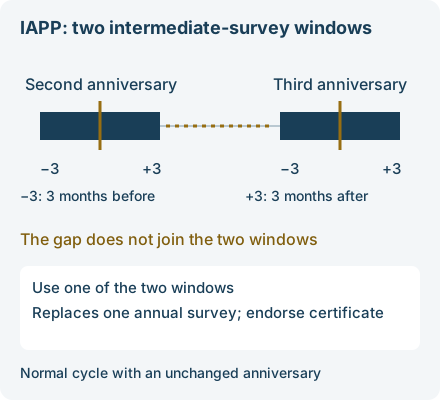
The two dark bars are the permitted windows, each extending three months before and after its anniversary. The gap is not included. This shows a normal cycle without an anniversary change; if an endorsement changes that date, reassess using the amended date. Annual surveys not replaced by the intermediate survey remain required.
Whether the renewal survey lands inside or outside the 3 months before expiry decides where the new period starts
1 An IAPP Certificate shall be issued for a period specified by the Administration, which shall not exceed five years.
The ceiling on the issued period is 5 years. Regulation 9.2 then splits the start of those 5 years three ways, by when the renewal survey was completed.
| When the renewal survey was completed | New certificate valid from | Ceiling on the new expiry date |
|---|---|---|
| Within 3 months before the old expiry date | Date the survey completed | 5 years from the old expiry date |
| After the old expiry date | Date the survey completed | 5 years from the old expiry date |
| More than 3 months before the old expiry date | Date the survey completed | 5 years from the date it completed |
.3 when the renewal survey is completed more than three months before the expiry date of the existing certificate, the new certificate shall be valid from the date of completion of the renewal survey to a date not exceeding five years from the date of completion of the renewal survey.
The first two rows inherit the old expiry date. Even a survey finished after expiry counts the next cycle from the old expiry date. Only the third row moves the start to the completion date. That is where the two ships in the opening part company. The one that finished 4 months before expiry pulls its next cycle forward by that much.
One exception hangs on the first row. Where the Administration determines that special circumstances apply, the new certificate need not be dated from the old expiry date. In that case it is valid up to 5 years from the date the renewal survey was completed (regulation 9.7).
Where a certificate was issued for less than 5 years, the Administration may extend its validity beyond the expiry date. The ceiling is the same 5 years. The surveys under regulation 5.1.3 and regulation 5.1.4 that would apply to a certificate issued for the full period have to be carried out as appropriate (regulation 9.3).
The special-circumstances provision in regulation 9.7 also refers to renewals following extensions under 9.5 and 9.6, not only 9.2.1. The formula for a renewal completed after expiry does not authorize operation with an expired certificate. Check extension and operating authority separately.
Where the new certificate is not on board by the expiry date, the extensions that open run to different lengths
4 If a renewal survey has been completed and a new certificate cannot be issued or placed on board the ship before the expiry date of the existing certificate, the person or organization authorized by the Administration may endorse the existing certificate and such a certificate shall be accepted as valid for a further period that shall not exceed five months from the expiry date.
- The renewal survey is done but the new certificate cannot be issued or placed on board. The person or organization authorized by the Administration endorses the existing certificate, and it is accepted as valid for up to 5 months from the expiry date (regulation 9.4).
- The ship is not in the port where it is to be surveyed when the certificate expires. The Administration may extend the validity, but only to let the ship complete its voyage to that port. The extension cannot run past 3 months, and on arrival the ship cannot leave that port without a new certificate (regulation 9.5).
- A ship engaged on short voyages that has not had either extension above. The Administration may grant a period of grace of up to 1 month from the expiry date stated on the certificate (regulation 9.6).
The same rider hangs on the last two. Once the renewal survey is completed, the new certificate cannot run past 5 years from the old expiry date as it stood before the extension was granted. Time bought by an extension does not stack onto the next cycle.
Missed surveys or endorsements can invalidate a certificate before expiry
9 A certificate issued under regulation 6 or 7 of this Annex shall cease to be valid in any of the following cases: .1 if the relevant surveys are not completed within the periods specified under regulation 5.1 of this Annex; .2 if the certificate is not endorsed in accordance with regulation 5.1.3 or 5.1.4 of this Annex; and .3 upon transfer of the ship to the flag of another State.
The first two grounds mean one thing. The certificate loses effect before the expiry date printed on it. Let an annual survey slip outside its window, or carry out the survey and fail to get the endorsement onto the certificate, and from that moment the ship has no valid certificate.
The same thing can happen during a survey. Where a nominated surveyor or recognized organization determines that the condition of the equipment does not correspond substantially with the particulars of the certificate, it ensures corrective action is taken and notifies the Administration. If that action is not taken, the Administration withdraws the certificate. If the ship is in a port of another Party, the port State authorities are notified immediately too.
A change of flag does not produce a new certificate on its own. The Government issuing the new certificate has to be fully satisfied that the requirements are met. Where the transfer is between Parties and a request comes within 3 months of it, the former flag State transmits copies of the certificate the ship carried before the transfer and of the survey reports.
Port State control looks at shipboard familiarity, not only at the dates on the certificate
1 A ship, when in a port or an offshore terminal under the jurisdiction of another Party, is subject to inspection by officers duly authorized by such Party concerning operational requirements under this Annex, where there are clear grounds for believing that the master or crew are not familiar with essential shipboard procedures relating to the prevention of air pollution from ships.
What opens this inspection is clear grounds. There have to be clear grounds for believing that
the master or crew are not familiar with the essential shipboard procedures for preventing air
pollution. Regulation 10.2 then has the Party take steps so that the ship does not sail until
the situation is brought to order. Every date on the certificate can line up and this door still
opens on its own.
Worth confirming
The passages above come from regulations 5, 6, 9 and 10 of the revised MARPOL Annex VI adopted by resolution MEPC.328(76), printed pages 12 to 19.
What the text fixes is the types of survey, the width of the windows, and where the new period starts for each renewal timing. What varies by flag State sits elsewhere.
- How long a certificate is issued for is set by the Administration, inside the ceiling of 5 years.
- What counts as the special circumstances in regulation 9.7 is for the Administration to determine.
- What measures apply to ships below 400 gross tonnage is set by the Administration as well.
- Whether officers of the Administration carry out the survey, or nominated surveyors or recognized organizations do, is also for the Administration.
Read alongside this that the same regulation 9 sets different periods for the International
Energy Efficiency Certificate and the Statement of Compliance. The International Energy
Efficiency Certificate is valid throughout the life of the ship, and the Statement of Compliance
only through the year it is issued and part of the following year. Carrying the IAPP cycle
across to them does not work.
You can consult the cited source documents
These links lead to the official publishers of the documents discussed here. Match the edition and provisions cited in the article, and check subsequent amendments and flag-state implementation before applying them.
Continue with the related operational guidance
The anniversary date comes out of the expiry date, and the window is 3 months either side of it. Bellbook keeps a ledger number, an expiry date and the survey history on each ship certificate, and the fleet calendar lists the surveys and expiries coming up in date order.
Start for freeRelated reading
- What each ship type records as cargo carried per voyage under EU MRV (EU Regulation 2016/1928)Environment and regulation
- Three ways an electronic record book differs from paper and the Administration's declaration (MEPC.314(74) and MEPC.312(74))Environment and regulation
- Entry into force and application dates of the Canadian Arctic and Norwegian Sea emission control areas (MEPC.392(82))Environment and regulation