Polar Code Part II discharge requirements for oil, noxious liquid substances, sewage and garbage and when they apply (MEPC.264(68))
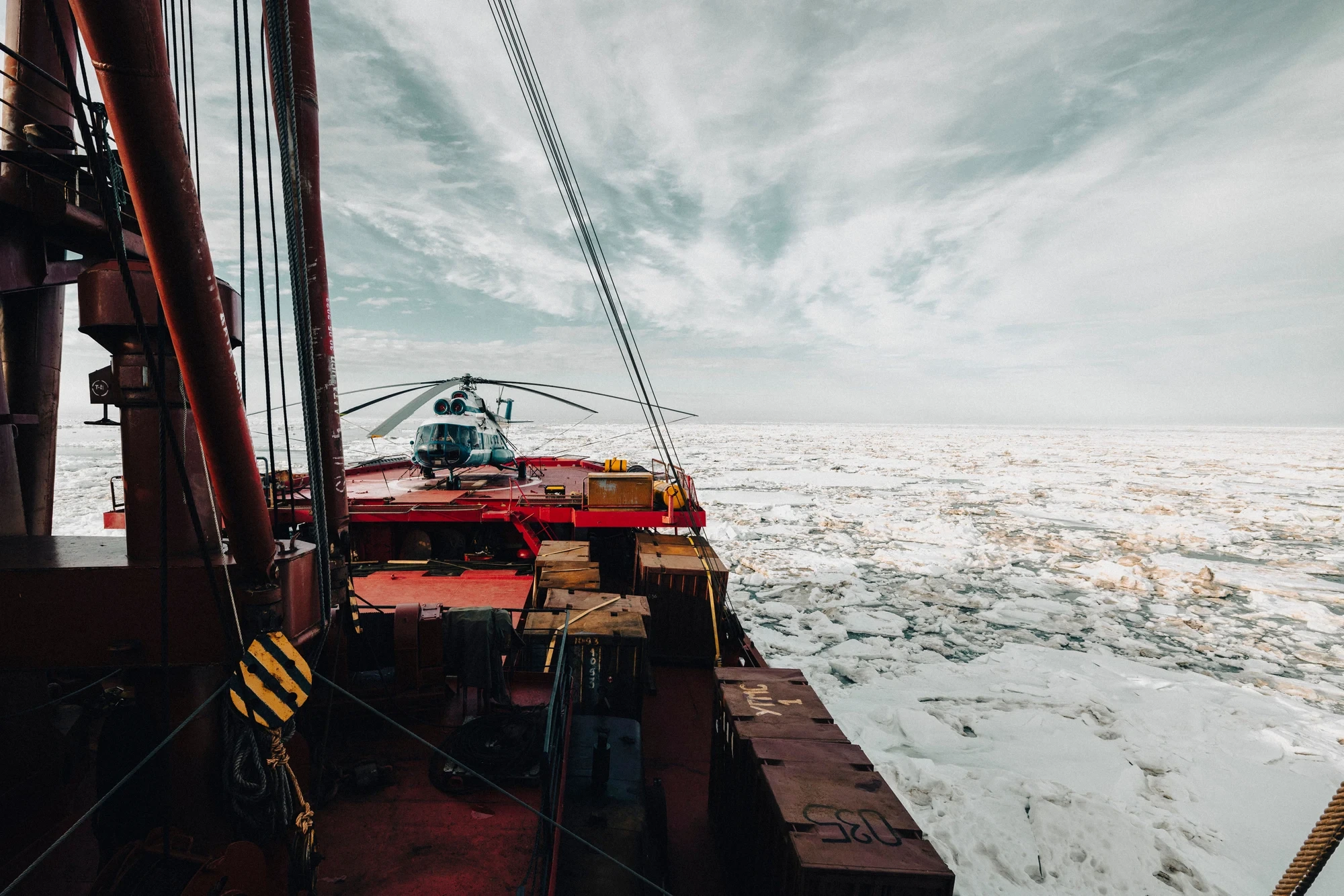
The Polar Code was adopted in two resolutions. The safety side (the Introduction and part I) is MSC.385(94) of 2014-11-21, and the environmental side (the Introduction and part II) is MEPC.264(68) of 2015-05-15. This article reads part II-A, the mandatory part of the environmental side.
Scope: These requirements apply only when operating in polar waters, meaning Arctic waters and the Antarctic area. The Antarctic area lies south of latitude 60 degrees south, and MARPOL Annex I Regulation 46.2 sets the Arctic waters boundary by coordinates. In other sea areas, only the MARPOL text applies.
The heavy fuel oil ban (Regulation 43A) and crew training are in the related article below and the STCW article. This article stays with discharges.
The application date differs between the MARPOL side and the SOLAS side
Part II-A was made mandatory not by the Code but by MEPC.265(68). That resolution put polar chapters into MARPOL Annexes I, II, IV and V and entered into force on 2017-01-01. The Code takes effect on the same day (MEPC.264(68) operative paragraph 3).
The safety side has a different date. SOLAS Regulation XIV/2.2, as replaced by MSC.532(107), gives time to ships certified under SOLAS chapter I and constructed before 2017-01-01. They must comply by the first intermediate or renewal survey after 2018-01-01. The MARPOL side has no such general grace period. It has only the category A ship clause in the oil section below.
| Annex | Polar chapter regulation | Ships covered | Code chapter |
|---|---|---|---|
| I | Regulation 47 | All ships operating in polar waters | Part II-A chapter 1 |
| II | Regulation 22 | Ships certified to carry noxious liquid substances in bulk | Part II-A chapter 2 |
| IV | Regulation 18 | Ships certified under Annex IV | Part II-A chapter 4 |
| V | Regulation 14 | All ships to which Annex V applies | Part II-A chapter 5 |
Chapter 3, the slot for Annex III, is blank. The Code text says it was kept blank intentionally. Categories A, B and C are ship classes by ice condition (Introduction 2.1 to 2.3). A is designed for at least medium first-year ice, B for at least thin first-year ice, and C for open water or ice conditions less severe.
In Arctic waters even the 15 ppm discharge closes
Paragraph 1.1.1 of part II-A prohibits discharge of oil and oily mixtures in Arctic waters. The reach is the same for any ship and any space.
any discharge into the sea of oil or oily mixtures from any ship
An oily mixture is a mixture with any oil content (Annex I Regulation 1.3). So the 15 ppm discharge under Regulation 15 is caught by this ban too. MEPC.265(68) aligned the regulation text by adding an Arctic waters exclusion to the titles of section A of Regulations 15 and 34. The Antarctic area was already closed as a special area (Regulations 15.4 and 34.3).
Clean and segregated ballast stay open (1.1.2). Discharges for safety or from damage also remain Regulation 4 exceptions. MEPC.265(68) amended Regulation 4 to reach 1.1.1.
The transitional clause is 1.1.3. It covers category A ships constructed before 2017-01-01 that operate continuously in Arctic waters for more than 30 days. If they could not comply for machinery space mixtures, they could, with Administration approval, follow Regulation 15.3 until the first intermediate or renewal survey one year after 2017-01-01.
Noxious liquid substances cannot be discharged in either polar region
In Arctic waters, discharge of noxious liquid substances and mixtures containing them is prohibited (part II-A 2.1.1). For the Antarctic area, Annex II Regulation 13.8.2 already says the same. That means none of the discharge conditions in the Annex II text can be used for Category X, Y or Z.
Category A and B ships constructed on or after 2017-01-01 have one more step. Carrying ship type 3 substances in chapter 17 column e of the IBC Code, or noxious liquid substances in its chapter 18, in cargo tanks of type 3 ships needs Administration approval. The result goes on the NLS certificate or Certificate of Fitness (2.1.3).
Sewage distance is measured from ice as well as from land
Ice distance is added to the Annex IV Regulation 11 standards. The Annex requirements stay and both apply (part II-A 4.2.1).
| Sewage state | Annex IV Regulation 11 | Distance added in polar waters |
|---|---|---|
| Comminuted and disinfected | Over 3 nautical miles from land | Over 3 nautical miles from ice-shelf or fast ice, as far as practicable from ice concentration over 1/10 |
| Not comminuted or disinfected | Over 12 nautical miles from land | Over 12 nautical miles from ice-shelf or fast ice, as far as practicable from ice concentration over 1/10 |
| Approved sewage treatment plant | Certificate test results and so on | As far as practicable from land, ice-shelf, fast ice and ice concentration over 1/10 |
For a new ship, the first two routes close. Category A and B ships and passenger ships constructed on or after 2017-01-01 may discharge only through an approved treatment plant (4.2.2). Constructed means the keel is laid or the ship is at a similar stage (4.1.1).
Long operation in ice has its own rule. Category A and B ships operating for extended periods in ice concentrations over 1/10 may discharge only through a treatment plant, whatever their construction date. That discharge needs Administration approval (4.2.3). A ship below the Annex IV Regulation 2 threshold, and so without a certificate, is outside Regulation 18.
Garbage has separate provisions for the Arctic and the Antarctic
Discharge in Arctic waters adds requirements to Annex V Regulation 4, and the Antarctic area adds them to Regulation 6. The general prohibition in Regulation 3 stays.
| Garbage | Outside polar and special areas (Regulation 4) | Arctic waters (5.2.1) | Antarctic area (Regulation 6 + 5.2.2) |
|---|---|---|---|
| Food wastes | Comminuted 3 nautical miles, otherwise 12 nautical miles | Comminuted only, at least 12 nautical miles from land, ice-shelf and fast ice | Comminuted only, at least 12 nautical miles from land, ice-shelf and fast ice |
| Food wastes on ice | No provision | Prohibited | Prohibited |
| Animal carcasses | As far from land as possible | Prohibited | No discharge basis in Regulation 6 |
| Cargo residues | 12 nautical miles, no harmful substances | Washing water only, all conditions met, at least 12 nautical miles | Washing water only, Regulation 6 conditions met, at least 12 nautical miles |
Food wastes must pass a 25 mm screen and must not be mixed with other garbage. In both regions the ship must stay as far as practicable from ice concentration over 1/10. Arctic hold washing water discharge needs four conditions at once (5.2.1.5). No substances harmful to the marine environment, port of departure and next port both within Arctic waters with no transit outside, no adequate reception facilities at those ports, and at least 12 nautical miles’ distance. The ship must also be en route.
Here is a hypothetical case. A category C cargo ship in Arctic waters is 15 nautical miles from land and 8 nautical miles from fast ice. Even comminuted food waste cannot go over the side now. Outside polar waters the distance would be enough, being over 3 nautical miles. The ship must keep it on board until it is more than 12 nautical miles from the fast ice.
The Annex V exceptions (Regulation 7) reach 5.2. Where keeping food wastes clearly presents an imminent health risk to people on board, the en route requirement does not apply under Code chapter 5 either. MEPC.265(68) amended Regulation 7.2.1 that way. That does not mean the distance requirements are lifted as well.
Polar operation has to reach the record books and manuals too
Part II-A ends each discharge chapter with the same demand. Polar operation is to be taken into account, as appropriate, in the relevant documents.
| Paragraph | Documents |
|---|---|
| 1.1.4 | Oil Record Books, manuals, shipboard oil pollution or marine pollution emergency plan |
| 2.1.2 | Cargo Record Book, the P&A Manual, NLS or marine pollution emergency plan |
| 5.2.3 | Garbage Record Book, Garbage Management Plan, placards |
It also matters where compliance is shown. The Polar Ship Certificate is a SOLAS-side certificate (MSC.385(94) part I-A 1.3). Environmental compliance is indicated on the IOPP Certificate and the NLS certificate. MEPC.265(68) added structural compliance to section 8 of Supplement Form A and section 11 of Form B of the IOPP Certificate. Resolution A.1120(30) paragraph 5.13 says Polar Code surveys happen within SOLAS and MARPOL surveys and are not a separate survey type.
There are structural requirements too. Category A and B ships constructed on or after 2017-01-01 keep oil fuel tanks (when aggregate oil fuel capacity is less than 600 m3) and sludge and bilge tanks at least 0.76 m from the outer shell (1.2). Check the small tank exemption and the oil tanker requirements in the original.
Worth confirming
Part II-B is a recommendation. It encourages applying Annex I Regulation 43 in Arctic waters and says to look at the certificate’s limiting conditions and tested temperature when selecting a ballast water management system (part II-B 4.2). This article did not cover ballast water requirements or anti-fouling guidance.
MEPC.1/Circ.856, the guidance on issuing revised certificates and manuals, appears only by name in an A.1120(30) footnote, and this article did not read its text. The Regulation 46.2 coordinates are long and are not reproduced. It also did not cover the safety requirements for fishing vessels and others that MSC.532(107) added to SOLAS chapter XIV. Check implementation for each Annex against flag State guidance.
You can consult the cited source documents
These links lead to the official publishers of the documents discussed here. Match the edition and provisions cited in the article, and check subsequent amendments and flag-state implementation before applying them.
Continue with the related operational guidance
- Garbage discharge conditions at sea and how special areas differ (MARPOL Annex V Regulations 3, 4 and 6)
- Sewage discharge conditions and the surveys and validity of the International Sewage Pollution Prevention Certificate (MARPOL Annex IV Regulations 2, 4, 8 and 11)
- The two dates and two exceptions in the Arctic ban on using and carrying heavy fuel oil (MARPOL Annex I Regulation 43A)
Bellbook is an operations platform for shipping companies: planned maintenance and certificates, audit prep, crew HR and payroll, and voyage reporting in one place.
Start for freeRelated reading
- Three ways an electronic record book differs from paper and the Administration's declaration (MEPC.314(74) and MEPC.312(74))Environment and regulation
- Packing, marking, documents, stowage and quantity limits for packaged harmful substances and the changed regulation numbers (MARPOL Annex III, MEPC.193(61))Environment and regulation
- The six conditions for oil discharge from a tanker cargo area and the ODME, slop tanks and Oil Record Book Part II (MARPOL Annex I Regulation 34)Environment and regulation