Crude oil washing (COW) PSC checks and how the Operations and Equipment Manual is matched against Oil Record Book Part II (Paris MoU PSCC 59/2026/09)
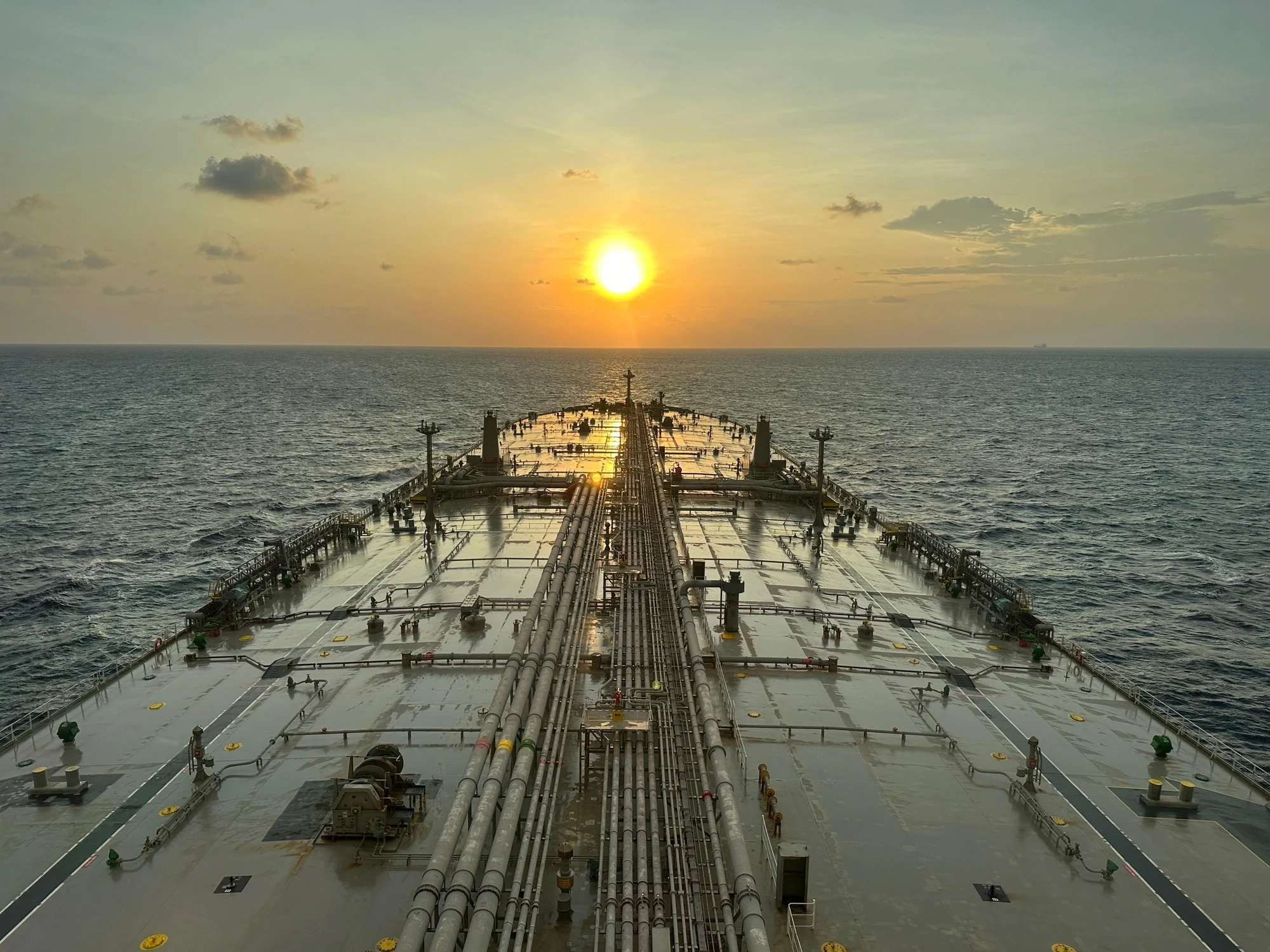
Crude oil washing (COW) cleans a tanker’s cargo tanks with crude oil instead of water. During discharge, cargo crude is sprayed through washing machines to wash out the residue left in the tank. Discharge standards, slop tanks and the discharge codes in Oil Record Book Part II have their own article. This one looks at how a PSC officer verifies the washing operation itself.
The source is the Paris MoU PSCC Instruction 59/2026/09 (Crude Oil Washing, Rev.1, 4 pages). It is guidance for PSCOs, and paragraph 2.2 says the inspection may cover the entire COW operation or only certain aspects of it. That is why the ship’s COW records have to be in order at all times. The PSCO can verify from the records operations that finished before the inspection.
Scope: Crude oil tankers discharging in ports of Paris MoU member Authorities. MARPOL Annex I regulation 33.1 requires a COW system on every crude oil tanker of 20,000 tonnes deadweight and above delivered after 1982-06-01. A ship not required to have one but fitted with COW equipment complies with the safety aspects of the IMO Specifications under regulation 33.2.
Regulation 35 sets the principles for the Manual and ballast tanks
Regulation 35 sets three things (MEPC.117(52)).
- A tanker operating with COW has an Operations and Equipment Manual covering the system, the equipment and operational procedures. The Manual is to the satisfaction of the Administration and is revised when the system is altered.
- Before each ballast voyage enough cargo tanks are crude oil washed that ballast goes only into tanks that have been crude oil washed.
- Unless the crude carried is not suitable for COW, the system is operated in accordance with the Manual.
The regulations paragraph 1.2 of the instruction cites are regulations 18, 33.1 and 33.3. It says the PSCO ensures that crude oil washing is performed by crude carriers that are required to have a COW system, or have chosen to install one, to comply with those regulations, and also verifies the operational requirements of the revised Specifications (resolution A.446(XI) as amended by A.497(XII) and A.897(21)). Paragraph 2.1 adds that the PSCO’s verification does not relieve terminal operators and shipowners of their obligations.
The PSCO looks at six documents
Paragraph 2.5 lists the documents to be available for inspection.
- The IOPP Certificate and the Record of Construction and Equipment, to see whether the ship has the COW system of regulation 33, and the validity and date of the Manual.
- The COW Operations and Equipment Manual
- Evidence that the Manual is to the satisfaction of the Administration
- Oil Record Book Part II
- The Cargo Ship Safety Equipment Certificate, to confirm that the inert gas system complies with SOLAS Chapter II-2
- Crew certification under STCW regulation V/1-1
Section 5.4 of the IOPP supplement for oil tankers is what item 1 checks. 5.4.1 is a COW system complying with regulation 33, 5.4.2 a system whose effectiveness has not yet been confirmed, 5.4.3 a valid Manual and its date, and 5.4.4 a system fitted without requirement but meeting the safety aspects. Regulation 33.1 gives one year after the tanker first carried crude, or the end of the third voyage carrying crude suitable for COW, whichever is later, to bring the system fully into compliance. 5.4.2 is the box for a ship in that period.
The Paris MoU deficiency codes include 14111 (SBT, CBT, COW) and 14112 (COW operations and equipment manual).
Personnel are verified by name, qualification and number
Paragraph 2.3 says the person in charge and the other nominated persons responsible for COW must be identified. If required, they must show that their qualifications meet 5.2 and 5.3 of the revised Specifications.
Paragraph 2.4 gives three ways to verify this. The individual’s discharge papers, testimonials issued by the ship’s operator, or certificates from a training centre approved by an Administration. The number of such personnel must be at least as stated in the Manual. The benchmark for numbers is therefore in the ship’s Manual, not in the instruction.
If washing conditions depart from the Manual, washing stops
Paragraphs 2.6 to 2.14 cover the conditions for starting and continuing washing.
| Condition | What the instruction checks | Paragraph |
|---|---|---|
| Inert gas | Instruments continuously indicating and permanently recording pressure and oxygen content in the supply main. The record shows whether the system worked properly before and during discharge | 2.6 |
| Tank oxygen | Oxygen measured at each tank to be washed. Meters must be calibrated and checked, and readings from tanks already washed must be available | 2.8 |
| Static electricity | Whether water in the crude is minimised (6.7 of the revised Specifications), confirmed from the cargo log or by asking the person in charge | 2.9 |
| Communication | Effective communication between the person in charge and the others involved | 2.10 |
| Leakage on deck | Whether the washing pipework was leak tested before discharge and the test noted in the Oil Record Book (where the PSCO is able) | 2.11 |
| Engine room exclusion | Isolating arrangements of the tank washing heater or pipework entering the machinery space | 2.12 |
| Crude suitability | Guidance and criteria in section 9 of the Manual | 2.13 |
| Pre-wash checklist | Whether the pre-COW operational checklist was done and all instruments worked | 2.14 |
When the conditions set in the Manual are not being met, paragraph 2.7 applies.
then the washing must be stopped until satisfactory conditions are restored.
This is the sentence in paragraph 2.7 (page 2). If the Manual’s conditions are not met, washing stops and does not resume until they are restored. Tank oxygen is a value paragraph 2.8 asks to be measured at the tank, so the supply main record alone cannot show the condition of each tank.
For each tank, ORB code D is matched against the Manual
Paragraph 2.18 asks for four things to be checked against the Manual for each tank being washed. Whether the machines are operating (by indicators, sound patterns or other approved methods), the programming of deck mounted machines, the duration of the wash, and the number of machines used at the same time. These values remain for each tank under code D (crude oil washing) in Oil Record Book Part II. Setting the items in Appendix III of MEPC.117(52) beside the instruction gives the following.
| Oil Record Book Part II code D | Manual condition the PSCO compares | Paragraph |
|---|---|---|
| 9. Port where washed, or ship’s position between two discharge ports | Tanks washed at earlier discharge ports or at sea | 2.15 |
| 10. Tanks washed | The preferred washing order in the Manual, and if different the reason and proposed order | 2.17 |
| 11. Number of machines in use | Not more than the number allowed simultaneously | 2.18 |
| 12, 15. Time washing started, time completed or stopped | Required duration of the wash | 2.18 |
| 13. Washing pattern (single or multi-stage) | Programming of deck mounted machines | 2.18 |
| 14. Washing line pressure | No corresponding check in the instruction | None |
| 16. Method of establishing that tanks were dry | Adequacy of stripping, by hand dipping at least at the aftermost dipping location or by other means described in the Manual | 2.20 |
A footnote in Appendix III says that when a tank has more machines than can be run at once, the section washed is identified (for example No.2 centre, forward section). For a multi-stage method, the vertical arc covered by the machines and the number of times it is covered are also entered.
Stripping has Manual values too. Paragraph 2.19 requires the minimum trim conditions and stripping parameters to be stated in the Manual. Paragraph 2.20 requires every crude oil washed tank to be stripped and checks that adequacy has been or will be confirmed before the ship leaves its final discharge port.
In a multi-port discharge the ballast tanks set the rule
Paragraphs 2.15 to 2.27 deal with ships discharging at several ports. The principles the instruction sets are these.
- Every tank that will or may hold ballast on the next voyage is crude oil washed before the ship leaves the port (2.15).
- There is no obligation to wash tanks other than ballast tanks at a discharge port. Those tanks must still be washed at least in accordance with 6.1 of the revised Specifications (2.15).
- All crude oil washing is completed before the ship leaves its final discharge port (2.16).
- Tanks washed at sea are entered in the Oil Record Book and left empty between discharge ports for inspection at the next one (2.21).
- The master or responsible officer decides which tanks to use for ballast. The Manual lists the designated ballast tanks (2.22).
- If crude is back-loaded into a designated ballast tank at an intermediate port, that tank is washed at a later port rather than at that port (2.22).
- The Oil Record Book is checked to confirm no additional ballast went into tanks not crude oil washed on previous voyages (2.23).
- Departure ballast tanks are stripped as completely as possible. If ballast was filled through cargo lines and pumps, those lines are stripped into another cargo tank or ashore through the special small diameter line (2.24).
- When departure ballast is shifted and discharged to sea, regulations 15 and 34 apply, and the PSCO checks this in the Oil Record Book (2.27).
The following timeline is invented for illustration. A crude oil tanker whose Manual designates 2C and 4C as ballast tanks discharges in two parts at port A and port B.
| When | What the ship did | What Oil Record Book Part II shows | What the PSCO can look at |
|---|---|---|---|
| Port A discharge | Crude oil washed 2C and 4C | Code D item 9 port A, items 10 to 17 per tank | Oxygen readings, machines and duration (2.8, 2.18) |
| Passage A to B | Crude oil washed 3C at sea | Code D item 9 ship’s position between the two discharge ports | Whether 3C is empty (2.21) |
| Port B discharge | Master decides 3C will also be departure ballast | 3C already washed, other tanks washed to the 6.1 minimum | Whether all ballast tanks are washed (2.15, 2.22) |
| Before leaving port B | Stripping and hand dipping of washed tanks | Code D item 16 method of confirming tanks dry | All crude oil washing completed (2.16, 2.20) |
The PSCO at port B cannot look into 2C and 4C, because ballast may already be in them. Whether those tanks were washed is checked in the Oil Record Book (2.15, 2.22). The code D entries made at port A are the main evidence. The oxygen readings in paragraph 2.8 concern tanks already washed in the port of inspection, so the instruction does not ask the PSCO at B for port A oxygen readings. 3C was washed at sea, so under paragraph 2.21 it has to be empty, and that condition is what the PSCO at B can see for real.
Worth confirming
This article leaves some things out, either because the instruction and MARPOL Annex I checked here do not answer them or because this article did not read the document concerned.
- The text of the revised Specifications (A.446(XI) as amended). This article did not check the details of personnel qualifications (5.2, 5.3), minimising water (6.7) or the minimum washing of non-ballast tanks (6.1).
- The crude suitability criteria in section 9 of the Manual. These differ by Manual, so look at the ship’s approved copy.
- Detention criteria for COW deficiencies. The five Annex I detention examples in the Detention and Action Taken guidance (PSCC 59/2026/03, 2.3.4.6) contain no item pointing directly to COW. Item .3 among them is the Oil Record Book not being available. That list is not exhaustive either, so the actual decision rests on the PSCO’s professional judgement.
- Paragraph 2.25 requires the Manual to give methods to avoid vapour emission where locally required. The instruction does not say which ports require it.
You can consult the cited source documents
These links lead to the official publishers of the documents discussed here. Match the edition and provisions cited in the article, and check subsequent amendments and flag-state implementation before applying them.
- Paris MoU · PSCC 59/2026/09
- IMO · MEPC.117(52)
- Paris MoU · PSCC 59/2026/03
- Paris MoU · List of Deficiency Codes (1 July 2026)
Continue with the related operational guidance
The PSCO checks the qualifications and numbers of the COW personnel against certificates and the Manual. The Bellbook crew certificates screen compares each seafarer with the required certificates the company has set by rank and ship type, marks a missing one as required, and outlines in red any certificate that expires before sign-off.
Start for freeRelated reading
- PSC inspections of ships carrying industrial personnel, application, headcount, training records and detention grounds (Paris MoU PSCC 57/2024/06)Crew and labour
- How Paris MoU PSCOs match seafarer certificates, flag State endorsements and the minimum safe manning document (PSCC 57/2024/05)Crew and labour
- Paris MoU load line inspections, matching documents, closing devices and marks, and when overloading leads to detention (PSCC 58/2025/12)Inspections and audits