Who may carry out weekly and monthly inspections and the annual and five-year thorough examinations of lifeboats, launching appliances and release gear (MSC.402(96))
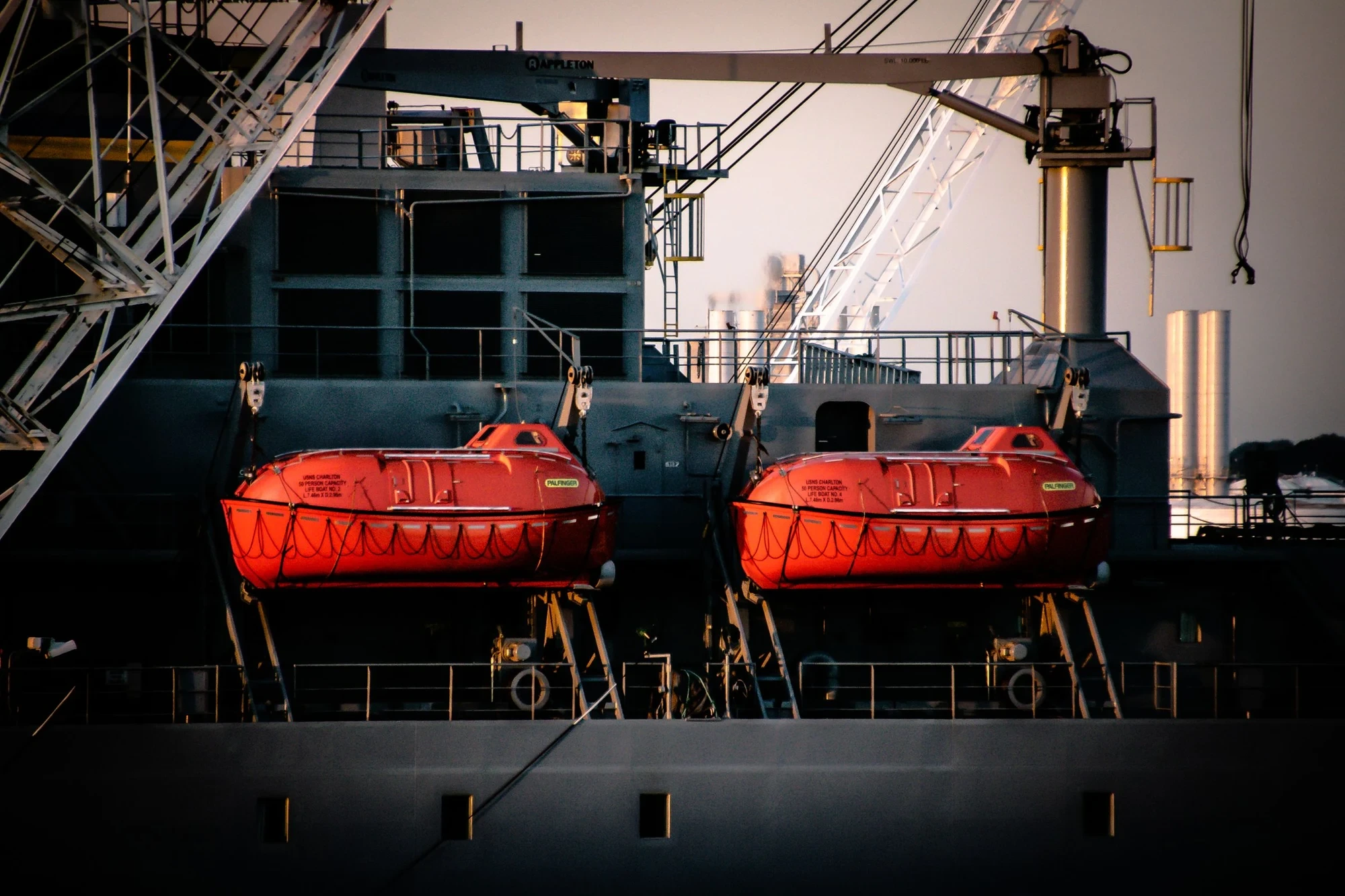
Servicing of lifeboats, rescue boats, launching appliances and release gear is governed by the Requirements adopted by resolution MSC.402(96). SOLAS regulation III/20 refers to these Requirements directly, so the ship’s maintenance manuals and the Company’s procedures have to match them. The resolution states that the Requirements take effect on 1 January 2020, with the entry into force of the associated SOLAS amendments.
The backbone of the Requirements is who does the work. Weekly and monthly inspections may be done by the crew, but from the annual thorough examination onward the work belongs to certified personnel of the manufacturer or an authorized service provider. The five-year examination includes an overload test and dismantling of the hooks, so the same certified personnel do it. A ship operator can become that service provider, but conditions attach.
Records split by interval as well. A report signed by the person who did the work and countersigned by the master, records kept on board for the service life of the equipment, and a statement of fitness issued by the provider that completed the work each land in a different place.
The Requirements apply to four kinds of equipment, and repair and overhaul are defined differently
2.1 These Requirements shall apply to the maintenance, thorough examination, operational testing, overhaul and repair of: .1 lifeboats (including free-fall lifeboats), rescue boats and fast rescue boats; and .2 launching appliances and on-load and off-load release gear for lifeboats (including primary and secondary means of launching appliances for free-fall lifeboats), rescue boats, fast rescue boats and davit-launched liferafts.
The equipment is lifeboats (including free-fall lifeboats), rescue boats, fast rescue boats, and the launching appliances and release gear for those boats and for davit-launched liferafts. The activities are five. Maintenance, thorough examination, operational testing, overhaul and repair.
Two words in the definitions are kept apart. Repair (2.2.6) is any activity that requires disassembly of the equipment, or any activity outside the scope of the on-board maintenance instructions and the emergency repair instructions. Overhaul (2.2.7) is a periodical activity defined by the manufacturer that proves continued fitness for purpose for a defined period, subject to correct maintenance. What the crew does by the manual is maintenance; once disassembly is involved it is repair. That boundary decides the “who” below.
The crew may do weekly and monthly inspections, and from the annual thorough examination onward certified personnel take over
4.1 Weekly and monthly inspections and routine maintenance as specified in the equipment maintenance manual(s), shall be conducted by authorized service providers, or by shipboard personnel under the direction of a senior ship’s officer in accordance with the maintenance manual(s).
4.2 Annual thorough examinations and operational tests, as described in section 6.2, shall be conducted by certified personnel of either the manufacturer or an authorized service provider in accordance with section 7 and section 8. The service provider may be the ship operator provided that it is authorized in accordance with section 3 and section 7.
4.3 Five-year thorough examination, any overhaul, overload operational tests, as described in section 6.3, and repair shall be conducted by certified personnel of either the manufacturer or an authorized service provider in accordance with section 7 and section 8.
| Interval or activity | Who may do it | Basis |
|---|---|---|
| Weekly and monthly inspections, routine maintenance | An authorized service provider, or shipboard personnel under the direction of a senior ship’s officer | 4.1 |
| Annual thorough examination and operational tests | Certified personnel of the manufacturer or an authorized service provider | 4.2 |
| Five-year thorough examination, overhaul, overload operational tests, repair | Certified personnel of the manufacturer or an authorized service provider | 4.3 |
What the crew may do stops at the weekly and monthly inspections and routine maintenance written in the manual. Even that is done under the direction of a senior ship’s officer and by the manual. From the annual examination onward it is certified personnel. Certification is given under section 8 by the manufacturer or an authorized service provider, for each make and type of equipment. When those personnel work on board they follow the instructions and procedures established by the Company (1.5).
A ship operator can be the service provider once the Administration has authorized it
The last sentence of 4.2 opens the door. The service provider may be the ship operator. The condition is authorization under section 3 and section 7. The Administration has to ensure that thorough examination, operational testing, repair and overhaul are carried out by service providers authorized under section 7 (3.1), and section 7 applies equally to manufacturers acting as service providers (3.2).
Section 7.1 lists the minimum to be demonstrated. Employment and documentation of personnel certified to a recognized standard or a manufacturer’s certification programme, sufficient tools including any specialized tools the manufacturer specifies, access to the parts and accessories needed for maintenance and repair, the manufacturer’s instructions for repair work involving disassembly or adjustment of on-load release mechanisms and davit winches, and a documented and certified quality system. The quality system has to cover a code of conduct, calibration of measuring tools, training programmes, supervision and verification, recording and reporting, quality management of subsidiaries and agents, job preparation, and periodic review of procedures, complaints and corrective actions.
.1 upon successful initial audit of a service provider, an authorization document shall be issued by the Administration defining the scope of services provided (e.g. makes and types of equipment). The expiry date shall be clearly written on the document;
Authorization comes as a document. After a successful initial audit the Administration issues an authorization document defining the scope of services, and the expiry date has to be clearly written on it (7.4). The Administration checks by periodic audit or otherwise that the work continues to meet the Requirements, and withdraws the authorization of providers that do not comply. It may also accept providers authorized by other Administrations or their recognized organizations. Where a manufacturer is no longer in business or no longer provides support, the Administration may authorize providers on the basis of prior authorization or long-term experience (7.3).
An operator that takes this route can have its own personnel carry out the annual examination of its own lifeboats. In exchange it has to meet all five items in 7.1, pass the Administration’s audit, and keep its hands off equipment outside the scope of its authorization document.
The annual thorough examination starts from the weekly and monthly checklists and ends with the winch brake test
The first part of the annual examination is nothing new. All the items on the checklists for the weekly and monthly inspections required by SOLAS regulations III/20.6 and III/20.7 form the first part of the annual thorough examination (6.2.1). Next, the records of inspections and routine maintenance carried out by the crew and the certificates for the equipment are reviewed (6.2.2). If the crew’s records are empty, the second step of the annual examination is empty.
For the boat itself, the structure with its fixed and loose equipment, the engine and propulsion system, the sprinkler system, the air supply system, the manoeuvring system, the power supply, the bailing system, the fender and skate arrangements and the rescue boat righting system are examined (6.2.3). For the release gear, after the annual operational test of the winch brake, the devices for activating the release, excessive free play, the hydrostatic interlock, the control and release cables and the hook fastening are examined (6.2.4). The Requirements attach two notes here. The setting and maintenance of release gear are critical operations for the safe operation of lifeboats, and no maintenance or adjustment is undertaken while the hooks are under load.
6.2.10 For winches of the launching appliances for lifeboats (including free-fall lifeboats), rescue boats, fast rescue boats and liferafts, annual operational testing shall be done by lowering the empty craft or boat or equivalent load. When the craft has reached its maximum lowering speed and before the craft enters the water, the brake shall be abruptly applied. Following these tests, the stressed structural parts shall be reinspected where the structure permits the reinspection.
The annual operational test of the winch is done by lowering the empty craft or an equivalent load. When the craft has reached its maximum lowering speed and before it enters the water, the brake is abruptly applied. The stressed structural parts are then reinspected. The step-by-step procedures for on-load and off-load release tests are in 6.2.5 and 6.2.6, for free-fall lifeboats in 6.2.7, and for the automatic release of davit-launched liferafts in 6.2.8.
The five-year examination requires an overload test at 1.1 times and dismantling of the hooks
6.3.1 The five-year operational test of the winches of the launching appliances shall be carried out with a proof load equal to 1.1 times the weight of the survival craft or rescue boat and its full complement of persons and equipment. When the proof load has reached its maximum lowering speed, the brake shall be abruptly applied.
The load for the five-year test is 1.1 times the weight of the survival craft or rescue boat with its full complement of persons and equipment. When that load has reached its maximum lowering speed, the brake is abruptly applied. The difference from the annual test is the load. Annual is the empty boat; five-year is 1.1 times the fully loaded weight.
6.3.3 The operational tests and overhaul at five-year intervals of release gear for lifeboats (including free-fall lifeboats), rescue boats, fast rescue boats and liferafts shall include: .1 dismantling of hook release units; .2 examinations with regard to tolerances and design requirements; .3 adjustment of release gear system after assembly; .4 operational tests as per paragraphs 6.2.5, 6.2.6, 6.2.7 or 6.2.8 above, as applicable, but with a load equal to 1.1 times the weight of the survival craft or rescue boat and its full complement of persons and equipment; and .5 examinations of vital parts with regard to defects and cracks.
The five-year work on release gear is an overhaul. The hook release units are dismantled, tolerances and design requirements are examined, the system is adjusted after assembly, the operational tests follow the same sequence as the annual tests but with the load raised to 1.1 times, and vital parts are examined for defects and cracks. Disassembly is involved, so by definition it falls under repair, which is why the certified personnel of 4.3 do it. Any other overhaul that is required follows the same 6.3.3 (6.3.4).
Reports are signed by the person who did the work and countersigned by the master, and records stay on board for the life of the equipment
5.1 All reports and checklists shall be completed and signed by the person who carries out the inspection and maintenance work and countersigned by the Company’s representative or the ship’s master.
5.2 Records of maintenance, thorough examination, operational testing, overhaul and repair shall be updated and filed on board the ship for the service life of the equipment.
5.3 When thorough examination, operational testing, overhaul and repair are completed, a statement confirming that the lifeboat arrangements remain fit for purpose shall be promptly issued by the manufacturer or authorized service provider that conducted the work. A copy of valid documents of certification and authorization as appropriate shall be included with the statement.
Records come in three layers. First, reports and checklists are completed and signed by the person who did the work and countersigned by the Company’s representative or the master. A weekly inspection by the crew belongs here too. Second, records of maintenance, thorough examination, operational testing, overhaul and repair are updated and filed on board for the service life of the equipment. The retention period is not a number of years but the life of the equipment. Third, when thorough examination, operational testing, overhaul or repair is completed, the manufacturer or service provider that did the work promptly issues a statement confirming that the lifeboat arrangements remain fit for purpose. Valid copies of the personnel certificates and the authorization document go with that statement.
The copies in the third layer matter. Whether the certification and authorization were valid is proven by the copies attached to the statement. A personnel certificate is valid for three years from the date of issue, and the expiry date has to be clearly written on it (8.3.1). Any shortfall in performance suspends the certificate, and it is revalidated only after a further competency assessment. Renewal also requires a competency assessment (8.3.2).
The manuals are part of the Requirements too. All work is carried out according to the manufacturer’s maintenance manuals and technical documentation, and the full set has to be on board (6.1.2). The manuals contain at least the items in 6.2 and 6.3 and are kept up to date by the Company, taking account of information from the manufacturer (6.1.3).
Worth confirming
The passages above come from the annex to resolution MSC.402(96). This article covers that text only.
- The Requirements connect to SOLAS regulations III/20 and III/36. The text of those two regulations is not covered here.
- The items of the weekly and monthly inspections are fixed by the equipment maintenance manual and SOLAS regulation III/20. The Requirements only say that those items form the first part of the annual examination.
- The education and training content for certified personnel is in 8.2. Which standard or programme is used for certification is for the provider and the Administration.
- Whether an Administration recognizes another Administration’s authorization is written in 7.4 as “may”. Check per flag State.
You can consult the cited source documents
These links lead to the official publishers of the documents discussed here. Match the edition and provisions cited in the article, and check subsequent amendments and flag-state implementation before applying them.
Continue with the related operational guidance
The person allowed to do the work differs by interval, so the records have to split by interval too. Bellbook registers lifeboats and launching appliances as equipment, keeps the maintenance items and completion reports per interval, and files the statement of fitness issued by the service provider in the ship document box ready for the next survey.
Start for freeRelated reading
- How reports from pilots and port authorities lead to a PSC inspection (EU Directive 2009/16 Article 23)Inspections and audits
- The order and duration of the Interim DOC and Interim SMC on the day the company changes (ISM Code chapter 14)Inspections and audits
- Seven HSSC survey types, the anniversary window, where the new period starts by renewal timing and how an extension is counted (Resolution A.1120(30))Inspections and audits